


How to Gain Knowledge of the Nepal Stock Market: A Beginner’s Guide
The Nepal stock market offers excellent opportunities for wealth creation, but success requires knowledge, patience, and discipline. Whether you are a student, working professional, or aspiring investor, understanding the fundamentals of the stock market is the first step toward making informed investment decisions.
1. Understand the Basics of the Nepal Stock Market
Before investing, learn how the Nepalese capital market operates. Familiarize yourself with key institutions such as:
- Nepal Stock Exchange (NEPSE)
- Securities Board of Nepal (SEBON)
- CDS and Clearing Limited (CDSC)
- Licensed stock brokers and merchant bankers
Understanding how shares are bought, sold, and settled will build a strong foundation for your investment journey.
2. Learn Fundamental Analysis
Fundamental analysis helps investors evaluate a company's financial health and long-term potential. Focus on:
- Earnings Per Share (EPS)
- Price-to-Earnings (P/E) Ratio
- Net Worth Per Share
- Dividend History
- Revenue and Profit Growth
- Management Quality
Investing in fundamentally strong companies can reduce risk and improve long-term returns.
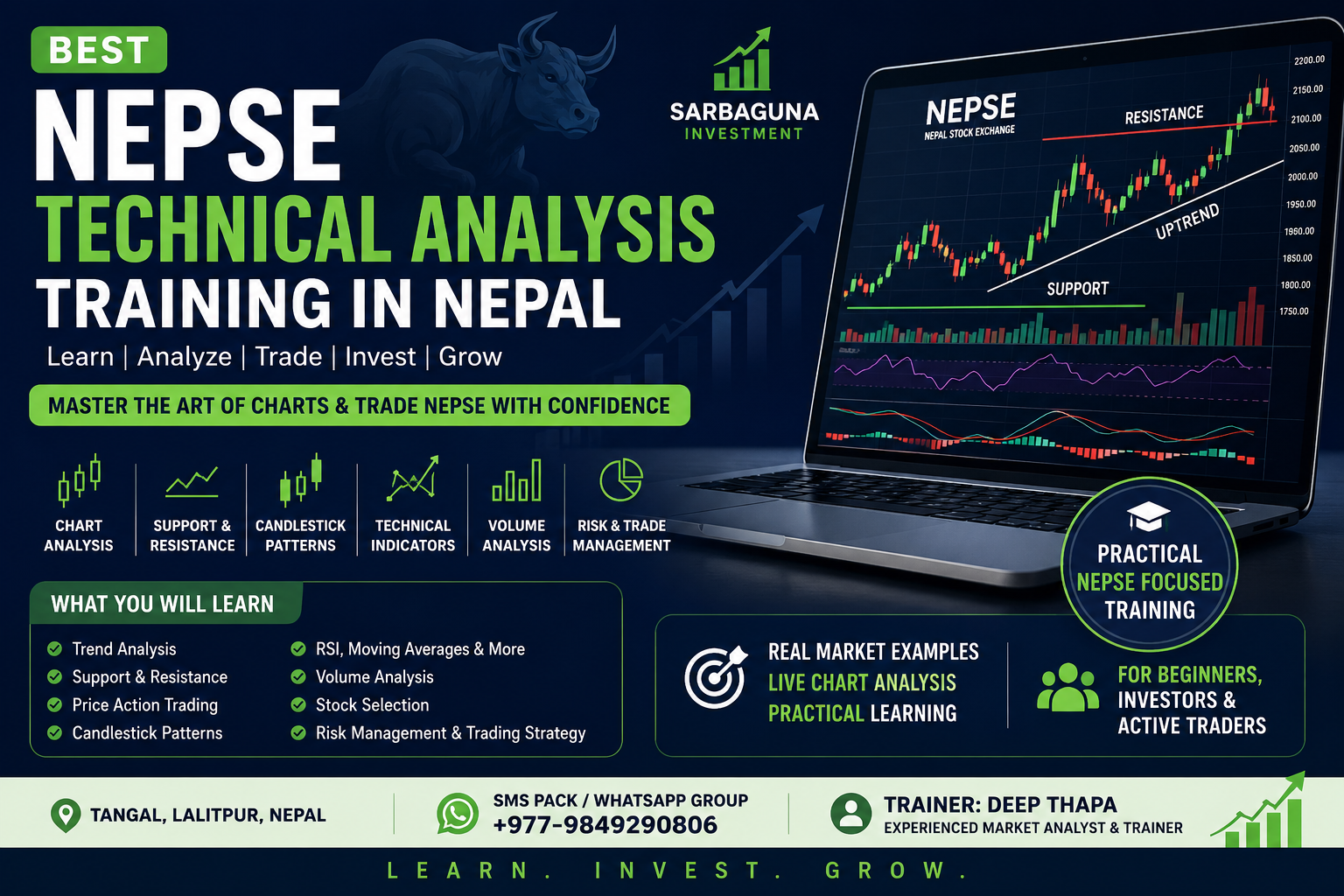
3. Study Technical Analysis
Technical analysis involves analyzing stock price movements and trading volume to identify market trends. Important concepts include:
- Support and Resistance
- Moving Averages
- RSI (Relative Strength Index)
- MACD
- Candlestick Patterns
- Volume Analysis
Technical analysis is particularly useful for traders looking to identify entry and exit points.
4. Follow Market News Daily
Stock prices are influenced by economic and company-specific developments. Stay updated with:
- NEPSE market updates
- Monetary policies
- Government budget announcements
- Corporate actions
- Quarterly and annual financial reports
Regular market monitoring helps investors understand market sentiment and trends.
5. Join Stock Market Training Programs
Structured training can accelerate your learning process. A professional stock market course can help you understand:
- Market operations
- Investment strategies
- Risk management
- Portfolio diversification
- Technical and fundamental analysis
Practical training often provides insights that are difficult to gain from self-study alone.
6. Practice with Small Investments
Start investing with a small amount of capital. Real market experience helps you:
- Understand market psychology
- Manage emotions during volatility
- Learn from mistakes with minimal risk
As your knowledge and confidence grow, you can gradually increase your investment size.
7. Read Books and Educational Resources
Continuous learning is essential in the stock market. Study books, articles, research reports, and educational content related to investing and trading. Learning from experienced investors can help you avoid common mistakes.
8. Join Investment Communities
Participating in investor groups and discussion forums can expose you to different market perspectives. However, always verify information independently and avoid making decisions solely based on tips or rumors.
9. Develop a Long-Term Mindset
Successful investing is not about quick profits. Focus on:
- Consistent learning
- Risk management
- Disciplined investing
- Long-term wealth creation
Patience often rewards investors more than frequent buying and selling.
Conclusion
Gaining knowledge of the Nepal stock market is a continuous process. By understanding market fundamentals, learning technical analysis, following financial news, and practicing disciplined investing, you can build the skills needed to navigate the market successfully. The more you invest in your education, the better prepared you will be to make informed investment decisions and achieve your financial goals.
Join Sarbaguna Investment
📊 Sarbaguna Investment – Empowering Smart Trading Decisions in NEPSE
👨💼 Market Expert: Deep Thapa
📩 SMS Pack / WhatsApp Group: +977-9849290806
💬 Get daily market updates, technical analysis, trading signals, investment insights, and stock market training.
Tags


Leave a Comments
Comments


Popular






Recent Post

No comments yet.