

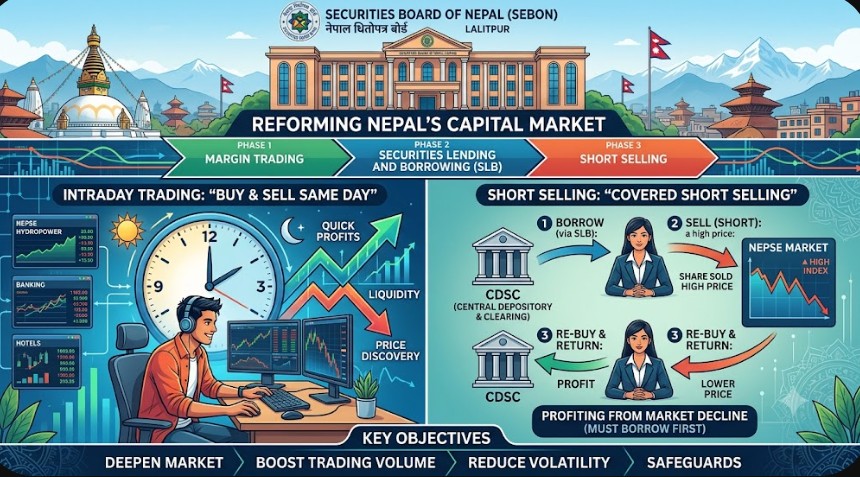
SEBON Plans Intraday Trading and Short Selling in Nepal: A Major Transformation for NEPSE
Nepal’s capital market could be heading toward one of the biggest structural changes in its history.
The Securities Board of Nepal (SEBON) is moving toward introducing intraday trading and short selling in Nepal, two trading mechanisms widely used in developed capital markets but currently unavailable to ordinary investors trading on the Nepal Stock Exchange (NEPSE).
The Government of Nepal has also included plans to introduce intraday trading, short selling and derivative instruments in phases as part of its capital-market reform agenda for fiscal year 2026/27.
SEBON’s Capital Market Development Blueprint of Nepal, 2026 further identifies intraday trading, short selling and securities lending and borrowing as important elements of Nepal’s future capital-market infrastructure.
If successfully implemented, these reforms could fundamentally change how investors trade shares in Nepal.
What Is Intraday Trading?
Intraday trading, also known as day trading, means buying and selling the same security within the same trading day.
For example:
An investor buys a NEPSE-listed stock at Rs. 500 in the morning.
Later that day, the price increases to Rs. 515.
Under an intraday trading system, the investor could sell the shares at Rs. 515 without waiting for the normal settlement process to complete.
Gross trading gain:
Rs. 515 – Rs. 500 = Rs. 15 per share
Actual profit would be lower after applicable brokerage fees, taxes and other transaction costs.
Current Situation in NEPSE
Nepal's existing market structure does not provide a conventional intraday trading facility comparable to mature international markets.
This limits the ability of active traders to react quickly to short-term movements.
Introducing intraday trading could therefore represent an important modernization of the NEPSE online trading system.
Why Does SEBON Want Intraday Trading?
One of the major objectives is expected to be improving liquidity and making Nepal's secondary market more dynamic.
Intraday trading can potentially:
- Increase trading activity and market liquidity
- Allow investors to respond quickly to market information
- Improve price discovery
- Create opportunities for professional and active traders
- Improve the usefulness of margin trading facilities
- Increase participation in highly liquid stocks
- Narrow the gap between Nepal and more developed securities markets
Earlier in 2026, SEBON had also identified intraday trading as a priority and studied its policy and technical requirements.
The reform has subsequently become part of the broader capital-market modernization agenda.
What Is Short Selling?
Short selling allows traders to potentially profit when the price of a security falls.
In a typical short-selling transaction, an investor:
- Borrows shares.
- Sells the borrowed shares in the market.
- Waits for the price to decline.
- Buys the shares back at a lower price.
- Returns the borrowed shares.
- Keeps the difference, after borrowing costs, taxes and transaction expenses.
Simple Short Selling Example
Suppose an investor believes a stock trading at Rs. 1,000 is overvalued.
The investor borrows and sells 100 shares at Rs. 1,000.
Total sale value:
100 × Rs. 1,000 = Rs. 100,000
Later, the stock falls to Rs. 900.
The investor buys back 100 shares:
100 × Rs. 900 = Rs. 90,000
Gross difference:
Rs. 100,000 – Rs. 90,000 = Rs. 10,000
The trader would still need to deduct borrowing charges, brokerage commissions, taxes and other costs.
However, if the share price rises instead of falling, the short seller suffers a loss.
Short Selling Could Change NEPSE's One-Way Market Structure
This could be particularly significant for Nepal.
Historically, NEPSE investors have largely needed share prices to increase in order to generate trading profits.
Short selling introduces another side to the market.
A trader who believes a company is undervalued can take a bullish position, while a trader who believes the company is overvalued could potentially take a bearish position.
SEBON Chairman Dr. Gopal Prasad Bhatta has explained that a healthy capital market should provide a fair playing field rather than create an expectation that stock prices must continuously rise.
Short selling could therefore contribute to more balanced price discovery in NEPSE.
Securities Lending and Borrowing Will Be Critical
Short selling cannot operate efficiently simply by allowing traders to click a "Sell" button without owning shares.
Nepal would require a proper Securities Lending and Borrowing (SLB) mechanism.
Under an SLB framework, investors or institutions holding shares could make eligible securities available for borrowing.
A short seller could borrow those securities, sell them and later purchase equivalent shares to return to the lender.
Therefore, the development of an SLB framework is likely to be one of the most important technical and regulatory foundations for short selling in Nepal.
SEBON's Capital Market Development Blueprint 2026
The reforms go far beyond intraday trading.
SEBON's Capital Market Development Blueprint of Nepal, 2026 presents a ten-year strategy for modernizing the country's securities market.
The blueprint discusses reforms involving:
Intraday Trading | Short Selling | Securities Lending and Borrowing | Digital Securities | Alternative Investment Funds | ETFs | REITs | Corporate Bonds | Green Bonds | Foreign Portfolio Investment | Improved Market Surveillance
This indicates that intraday trading and short selling should be viewed as part of a much broader transformation of Nepal's capital market rather than isolated trading features.
What Could Intraday Trading Mean for NEPSE Investors?
The introduction of intraday trading could create an entirely new category of active NEPSE traders.
Currently, many investors primarily focus on positional or medium-term trades.
Intraday trading would encourage greater attention to:
- Short-term support and resistance
- Trading volume
- Market momentum
- Price action
- Breakouts and breakdowns
- Moving averages
- VWAP
- RSI
- Candlestick patterns
- Risk-to-reward ratios
- Stop-loss management
This could significantly increase demand for technical analysis training in Nepal and professional NEPSE trading education.
Potential Benefits for NEPSE
Higher Market Liquidity
Intraday traders can execute multiple transactions during a trading session, potentially increasing market turnover.
Higher liquidity generally makes it easier for investors to enter and exit positions.
Better Price Discovery
Buyers and sellers continuously expressing opposing views can help securities reach prices that more efficiently reflect available information.
More Professional Trading
NEPSE could gradually evolve from a predominantly delivery-oriented retail market toward a more sophisticated trading ecosystem.
Opportunities in Falling Markets
Short selling would allow qualified traders to potentially profit from declining securities instead of depending exclusively on bullish markets.
Development of New Strategies
Traders could develop momentum, breakout, mean-reversion, hedging and market-neutral strategies as Nepal's trading infrastructure develops.
But Intraday Trading Is Not Easy Money
The introduction of intraday trading should not be interpreted as guaranteed profit for NEPSE investors.
Day trading involves substantial risk.
Frequent transactions can generate higher brokerage costs and taxes, while leverage can magnify losses.
Successful intraday trading generally requires:
Trading Plan + Technical Analysis + Position Sizing + Stop Loss + Risk Management + Discipline
Without proper risk management, the ability to trade more frequently can actually increase losses.
Short Selling Carries Even Greater Risk
Short selling has a particularly important risk characteristic.
When you buy a stock normally, the theoretical maximum loss is the amount invested if the share price falls to zero.
A short seller faces a different risk structure because a stock price can theoretically continue rising.
For example, someone shorting a stock at Rs. 500 could face significant losses if the stock rises to Rs. 600, Rs. 700 or higher.
Therefore, SEBON and other market institutions will need strong regulations covering areas such as eligible securities, margin requirements, collateral, position limits, settlement, securities borrowing, forced close-outs and market manipulation.
Will Every NEPSE Stock Be Available for Short Selling?
Not necessarily.
SEBON has not yet established the final operational rules determining exactly which listed securities will qualify.
A prudent framework could potentially consider factors such as liquidity, market capitalization, free-float shares, trading frequency and historical turnover when determining eligibility.
The final rules should therefore be awaited before investors assume that every NEPSE-listed company will be available for short selling.
When Will Intraday Trading and Short Selling Start in Nepal?
There is currently no confirmed public launch date for full implementation.
The important distinction for investors is between policy intention and actual implementation.
The government has announced phased introduction of these instruments, and SEBON's 2026 blueprint provides a strategic framework for intraday trading, short selling and securities lending and borrowing.
SEBON Chairman Dr. Gopal Prasad Bhatta has also indicated that the regulator intends to move toward short selling soon.
However, implementation requires regulatory rules, technical systems, clearing and settlement arrangements, risk-management mechanisms and coordination among SEBON, NEPSE, CDSC and brokers.
Investors should therefore wait for an official implementation notice and detailed trading rules.
What Could Change in NEPSE After Implementation?
If properly implemented, intraday trading and short selling could significantly alter trading behaviour in Nepal.
NEPSE could experience:
Higher Turnover → Higher Liquidity → Faster Price Discovery → More Trading Strategies → Greater Need for Risk Management
The reforms could also increase demand for professional market research, real-time data, chart analysis and technical trading education.
At the same time, regulators would need stronger surveillance because sophisticated trading mechanisms can also create opportunities for excessive speculation and manipulation if controls are weak.
A New Era for Nepal's Share Market?
Nepal's capital market has expanded rapidly in terms of investor participation, technology and public interest.
However, the trading mechanisms available to investors remain relatively limited compared with developed markets.
SEBON's plans for intraday trading, short selling and securities lending and borrowing could therefore represent an important structural transition for NEPSE.
The reforms could allow investors to trade both bullish and bearish market views while increasing liquidity and improving price discovery.
But sophisticated trading tools also bring sophisticated risks.
The success of these reforms will ultimately depend on strong regulation, reliable technology, efficient settlement, investor education and disciplined risk management.
For NEPSE traders, learning these concepts before implementation may be more valuable than waiting until the new systems become operational.
Learn Intraday Trading & Technical Analysis in Nepal
Want to prepare yourself for the next generation of NEPSE trading in Nepal?
Sarbaguna provides share market education covering technical analysis, chart reading, trading strategies and risk management.
Learn topics including:
NEPSE Technical Analysis
Intraday Trading Strategies
Candlestick Pattern Analysis
Support and Resistance
RSI & MACD Analysis
Moving Average Trading
Volume Analysis
Trading Psychology
Risk Management
NEPSE Chart Analysis
Explore more stock-market learning resources at Sarbaguna.com.
Frequently Asked Questions (FAQ)
Is intraday trading available in Nepal?
A conventional intraday trading system is not yet fully operational on NEPSE. However, the government and SEBON have included intraday trading in their capital-market reform plans.
Is short selling legal in Nepal?
A conventional regulated short-selling mechanism is not currently operational for ordinary NEPSE trading. SEBON is working toward creating the necessary regulatory and market framework.
When will short selling start in Nepal?
SEBON has indicated that short selling is being prepared, but a definitive operational launch date and complete trading rules have not yet been announced.
What is intraday trading?
Intraday trading involves buying and selling securities during the same trading session rather than holding the position overnight.
Can traders make money when NEPSE falls?
Currently, ordinary investors mainly rely on owning securities and benefiting when prices rise. A properly implemented short-selling system would create a mechanism through which traders could potentially profit from declining prices.
What is securities lending and borrowing?
Securities Lending and Borrowing, or SLB, is a system through which an investor temporarily lends securities to another market participant. It is an important infrastructure component for regulated short selling.
Is short selling risky?
Yes. Short selling can involve substantial losses when the price of a shorted security rises instead of falling. Proper margin, position sizing and risk-management rules are essential.
Will intraday trading increase NEPSE turnover?
It could. Because intraday traders can buy and sell during the same session, successful implementation may increase transaction frequency and market liquidity.
Tags


Leave a Comments
Comments



Popular




Recent Post

No comments yet.