

Nepal’s Economy Is Running on Fear: Impact on NEPSE, Business & Investors
Nepal’s economy is facing a difficult combination of weak economic growth, political uncertainty, declining business confidence and cautious investment sentiment. While headline economic indicators may suggest that the economy is still expanding, the mood among businesses and investors tells a more complicated story.
According to a June 29, 2026 report by Nepal News, Nepal’s private sector has increasingly shifted its attention from expansion and investment toward uncertainty and risk. The September 2025 unrest caused significant economic damage, while subsequent political developments and an aggressive anti-corruption drive have added another layer of uncertainty for businesses.
For investors, the biggest question is not simply whether Nepal’s GDP will grow. The bigger question is whether confidence, investment and risk appetite can return to the economy and Nepal Stock Exchange (NEPSE).
From Economic Optimism to Uncertainty
Nepal entered 2026 with expectations of stronger economic activity and a potential recovery in private investment. However, those expectations have weakened.
The September 8–9, 2025 unrest became a major shock for Nepal’s private sector. Businesses were damaged, properties were attacked and significant investment was lost. The World Bank’s Nepal Development Update estimated the economic losses from the unrest at approximately 1.3% of GDP.
But the financial cost is only part of the problem.
The bigger problem is confidence.
Businesses make investment decisions based not only on expected returns but also on their perception of risk. When entrepreneurs become uncertain about political stability, regulatory decisions, taxation, enforcement or future policies, they may delay:
- New investments
- Factory expansion
- Hiring
- Capital expenditure
- Business acquisitions
- Stock-market investments
This creates a cycle where uncertainty reduces investment, lower investment slows growth, and slower growth further weakens confidence.
Nepal’s Economic Growth Is Below Expectations
Preliminary estimates cited by Nepal News indicate that Nepal’s economy could reach approximately Rs. 6.6 trillion in FY 2025/26, with real GDP growth of around 3.85%.
That figure is significantly below the government’s original 6% growth target.
The World Bank has also warned that growth could weaken further under adverse conditions, with its assessment incorporating the effects of the September unrest and geopolitical tensions.
This gap between targeted growth and actual expected growth is important for investors because economic growth ultimately influences:
Business earnings → corporate profits → employment → credit demand → investment → stock-market valuations
When economic activity remains weak, investors need to be more selective about companies and sectors.
Why Investor Confidence Matters for NEPSE
The Nepal Stock Exchange (NEPSE) is not a perfect representation of Nepal’s real economy, but it is an important indicator of investor sentiment.
A July 2026 Nepal News report noted that NEPSE had fallen to around 2,600 points, its lowest level in six months, with investor confidence weakened by policy uncertainty, cautious institutional investors and limited market-support measures.
A separate Nepal News analysis reported that NEPSE had declined from around 2,950 points before the new government took office to roughly 2,570 points by mid-July.
This illustrates an important market principle:
The stock market often reacts to expectations before economic statistics fully reflect the change.
Investors may sell shares today because they expect weaker earnings, lower liquidity or greater uncertainty several months from now.
Fear Can Become a Self-Reinforcing Economic Cycle
Economic fear can create a negative feedback loop.
1. Political uncertainty increases
Businesses become cautious about future regulations and government decisions.
2. Investment slows
Companies postpone expansion and capital expenditure.
3. Economic activity weakens
Lower investment can reduce demand, employment and business activity.
4. Corporate earnings come under pressure
Weak demand can affect sales and profitability.
5. Investors become defensive
Investors prefer cash, fixed-income instruments or fundamentally stronger companies.
6. NEPSE faces selling pressure
Reduced risk appetite can push stock prices lower.
7. Negative sentiment becomes stronger
Falling markets can further damage investor confidence.
Breaking this cycle requires more than simply pushing the stock market higher. Nepal needs predictable policy, stronger institutions, productive investment and confidence in the business environment.
What Does This Mean for Nepal Stock Market Investors?
For NEPSE investors, the current environment calls for greater emphasis on risk management and fundamental analysis.
Instead of asking only:
“Will NEPSE go up?”
investors should also ask:
- Is the company generating profit?
- Is revenue growing?
- Is debt manageable?
- Is the company generating cash?
- Is the valuation reasonable?
- Is the sector benefiting from economic conditions?
- What is the technical trend?
- Where are important support and resistance levels?
- What happens if the broader market falls another 5–10%?
This approach is particularly important during uncertain market conditions.
NEPSE Technical Analysis Still Matters
Economic fundamentals explain the broader environment, but technical analysis can help investors understand market behavior.
Important indicators to monitor include:
NEPSE Support and Resistance
Support zones can indicate areas where buying interest may emerge, while resistance zones can identify areas where selling pressure may increase.
RSI
The Relative Strength Index can help identify momentum conditions and potential overbought or oversold areas.
Moving Averages
Short-term and long-term moving averages can help investors identify whether the market is trending upward, downward or sideways.
Volume
Price movement supported by strong trading volume can provide stronger confirmation than price movement occurring on very low volume.
Pivot Levels
Daily, weekly and monthly pivot levels can help traders identify potential support, resistance and reversal zones.
However, no single technical indicator should be treated as a guaranteed prediction.
What Could Restore Confidence in Nepal’s Economy?
A sustained improvement in confidence would likely require several factors working together.
1. Policy Stability
Businesses need predictable policies and regulations.
2. Stronger Rule of Law
Anti-corruption efforts can strengthen the economy when they are transparent, consistent and based on clear legal processes.
3. Higher Capital Formation
Nepal needs productive investment rather than excessive idle capital.
4. Better Credit Transmission
Banks need to channel available liquidity into productive economic activities.
5. Infrastructure Development
Investment in energy, roads, tourism, technology and industrial infrastructure can create long-term economic capacity.
6. Stronger Investor Confidence
Retail and institutional investors need confidence that Nepal’s capital market offers fair rules, transparency and opportunities for long-term wealth creation.
What Should Investors Watch Next?
For Nepalese investors, the next phase should be monitored through several indicators:
NEPSE Index:
Watch whether the market establishes a sustainable base or continues making lower lows.
Market Turnover:
Rising prices accompanied by healthy turnover can provide stronger confirmation of buying interest.
Banking Liquidity and Interest Rates:
Credit growth and borrowing costs can significantly affect businesses and equity valuations.
Corporate Earnings:
Quarterly financial statements should remain a major source of investment decisions.
Government Policy:
Budget implementation, monetary policy and regulatory changes can influence market expectations.
Investor Sentiment:
Fear-driven selling can create opportunities, but it can also produce prolonged declines.
Is This a Crisis or an Opportunity?
For long-term investors, periods of fear can create opportunities—but only when valuations and fundamentals justify taking that risk.
A falling market does not automatically mean that every stock is cheap.
Likewise, a strong company can remain a poor investment if its valuation is excessive.
The key is to separate:
Market fear from fundamental deterioration.
If fear pushes fundamentally sound companies below reasonable valuations, disciplined investors may find attractive opportunities.
But if falling prices reflect deteriorating earnings, excessive debt or structural problems, simply buying because a stock has fallen can be dangerous.
Learn NEPSE Analysis Before Making Investment Decisions
Understanding the Nepal stock market requires more than following daily price movements.
Investors can improve their decision-making by learning:
- Fundamental analysis
- Technical analysis
- Candlestick patterns
- Support and resistance
- Pivot point analysis
- RSI and MACD
- Moving averages
- Volume analysis
- Sector analysis
- Risk management
- Portfolio management
- NEPSE chart analysis
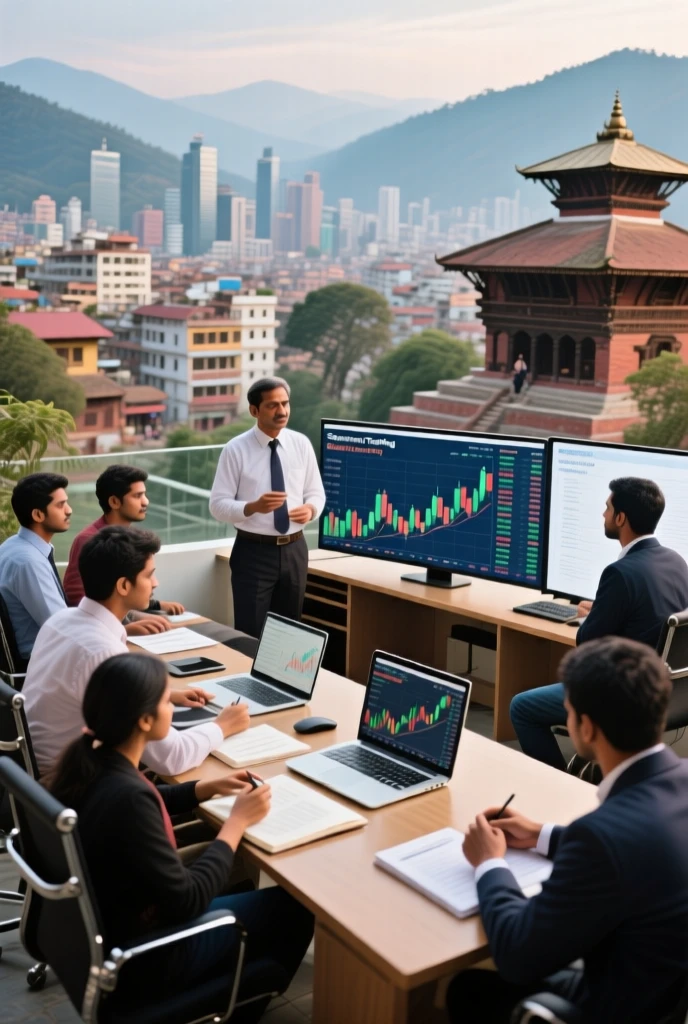
For readers looking for share market training in Nepal, Sarbaguna provides educational resources and market-focused learning designed to help investors understand the Nepalese stock market.
Those searching for NEPSE analysis courses in Nepal, share market training Nepal, stock market training Nepal, NEPSE chart analysis training and investment training Nepal can explore Sarbaguna’s educational resources.
Final Thoughts
Nepal’s current economic challenge is not simply about GDP growth.
It is fundamentally a confidence problem.
The damage from the 2025 unrest, uncertainty surrounding businesses, weaker-than-targeted economic growth and declining investor sentiment have created a challenging environment for both businesses and the capital market.
For NEPSE investors, this environment demands discipline rather than panic.
Investors should focus on company fundamentals, valuation, technical trends, market liquidity, risk management and long-term economic developments instead of reacting emotionally to every market movement.
Fear can damage an economy—but confidence built on strong institutions, predictable policies and productive investment can eventually become the foundation for recovery.
Frequently Asked Questions (FAQ)
What is happening to Nepal’s economy in 2026?
Nepal’s economy is facing weaker-than-targeted growth and reduced business confidence. Preliminary estimates cited by Nepal News put FY2025/26 real GDP growth at approximately 3.85%, below the government’s 6% target.
Why is investor confidence weak in Nepal?
Political uncertainty, the economic impact of the September 2025 unrest, business-related investigations, policy uncertainty and weak market performance have contributed to cautious investor sentiment.
How is Nepal’s economy affecting NEPSE?
Weak confidence can reduce risk appetite and investment, putting pressure on share prices and market turnover. NEPSE fell significantly during 2026 as investor expectations weakened.
Is NEPSE a reflection of Nepal’s economy?
NEPSE is not a complete measure of economic activity, but it can provide useful information about investor expectations and confidence.
Should investors buy shares when NEPSE is falling?
A falling market can create opportunities, but investors should not buy solely because prices have declined. Company fundamentals, valuation, earnings, debt, technical trends and risk should be evaluated first.
What should NEPSE investors analyze?
Investors should consider both fundamental and technical analysis, including earnings, valuation, debt, support and resistance, RSI, MACD, moving averages, volume and pivot levels.
Where can I learn share market analysis in Nepal?
Investors looking for share market training in Nepal, NEPSE analysis training, stock market investment training and technical analysis courses can explore Sarbaguna for market education and learning resources.


Leave a Comments
Comments
Popular



Recent Post

No comments yet.