

Linda Raschke Trading Rules: Make Fewer Decisions & Trade Better
Linda Raschke’s Trading Rule: Make Fewer Decisions During Market Hours
Successful trading is not always about making more decisions. In fact, legendary trader Linda Raschke emphasizes an important principle: reduce the number of decisions you need to make during the trading day.
For traders in Nepal, this is particularly relevant when participating in the NEPSE (Nepal Stock Exchange), where market movements can quickly trigger emotions, impulsive entries, and poorly planned exits.
The best traders often do much of their thinking before the market opens.
Instead of reacting emotionally to every price movement, they prepare a clear trading plan, identify important levels, define potential setups, and decide how they will respond to different market scenarios.
Why Reducing Trading Decisions Matters
Every decision requires mental energy.
During a live trading session, prices can move quickly. A trader may suddenly ask:
- Should I buy now?
- Should I wait?
- Should I sell?
- Should I book profit?
- Should I move my stop-loss?
- Is this a breakout?
- Is the market going to reverse?
Making these decisions repeatedly can lead to overtrading and emotional trading.
A better approach is to prepare your trading plan before the market opens.
When your potential entry, stop-loss, target, position size, and market conditions are already defined, you have fewer decisions to make when volatility increases.
Plan Before the Market Opens
One of the most useful habits for a stock market trader is creating a pre-market trading plan.
Before trading begins, consider:
1. Identify the Market Trend
Determine whether the broader market is showing a bullish, bearish, or sideways structure.
For NEPSE traders, this may include studying:
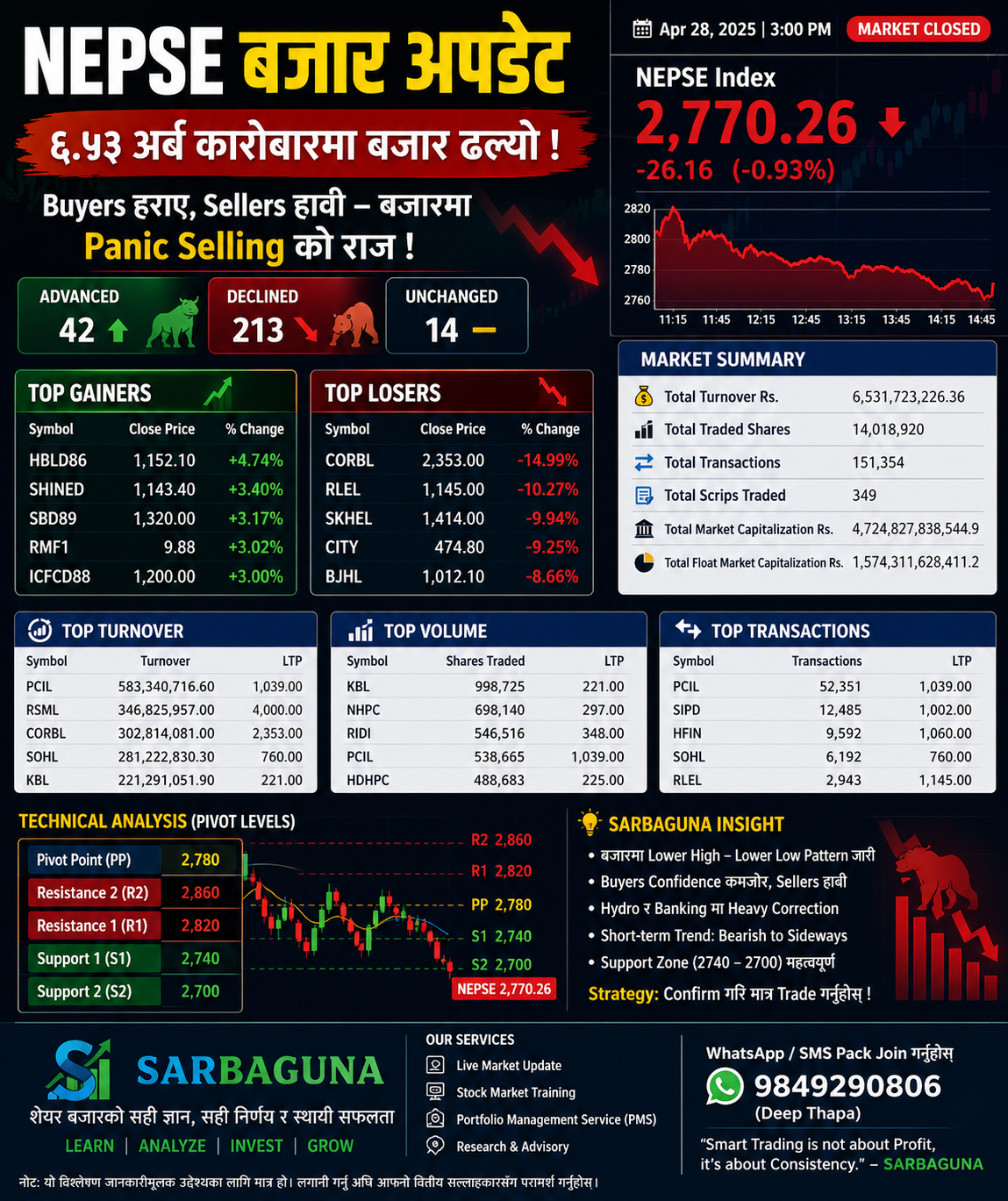
- NEPSE index trend
- Support and resistance
- Market breadth
- Trading volume
- Sector performance
- Previous session high and low
- Technical indicators
Understanding the broader market environment can help you avoid taking trades that conflict with the prevailing trend.
2. Mark Important Price Levels
Identify important technical levels before the market opens.
These can include:
- Support zones
- Resistance zones
- Previous day high and low
- Breakout levels
- Breakdown levels
- Pivot levels
- Moving averages
- Recent swing highs and lows
Having these levels prepared means you don't need to rediscover them while the market is moving quickly.
3. Define Your Trading Setup
Do not enter a trade simply because a stock is moving.
Instead, decide in advance what type of setup you are looking for.
For example:
“If price breaks resistance with strong volume and confirms the breakout, I will consider an entry.”
This approach is very different from:
“The stock is going up, so maybe I should buy.”
The first is a planned trading decision. The second is an emotional reaction.
Know What You Will Do Before You Trade
A trading plan should cover multiple possible scenarios.
For example:
Scenario A — Breakout
If resistance breaks with confirmation and volume, consider the planned entry.
Scenario B — Failed Breakout
If price breaks resistance but quickly falls back below the level, avoid chasing the trade or follow the predetermined exit rule.
Scenario C — No Setup
If the market does not provide the planned setup, do nothing.
That last decision is extremely important.
Not trading is also a trading decision.
Fewer Decisions Can Mean Better Discipline
Trading discipline becomes easier when you don't have to improvise constantly.
Suppose a trader enters a stock without knowing where to exit. Once the price starts falling, several emotional questions appear:
“Should I hold?”
“Should I average down?”
“Should I sell?”
“Maybe it will recover tomorrow.”
This is how a small planned loss can become a much larger loss.
A disciplined trader decides the risk before entering the trade.
That may include:
- Entry price
- Stop-loss
- Profit target
- Risk per trade
- Position size
- Maximum daily loss
- Conditions for exiting
The objective is not to predict every market movement.
The objective is to prepare for the possibilities.
Pre-Market Preparation for NEPSE Traders
If you trade or invest in the Nepalese share market, a structured morning routine can make your trading process more systematic.
Before the NEPSE session begins, you can review:
- Previous day's NEPSE movement
- Major support and resistance levels
- Stocks showing unusual volume
- Sector performance
- Corporate announcements
- Market sentiment
- Technical setups
- Potential entry and exit zones
- Risk-to-reward ratio
- Your maximum acceptable loss
You can then create a watchlist instead of monitoring every listed company.
This can significantly reduce unnecessary decisions during the trading session.
Avoid the Trap of Constant Market Watching
More screen time does not automatically mean better trading.
Constantly watching prices can create a temptation to trade every small movement.
A stock moves 2% — you want to buy.
Another stock drops — you want to sell.
A breakout appears — you chase it.
A small correction occurs — you panic.
This cycle can lead to overtrading, which can damage both trading performance and psychology.
Having a predefined plan allows you to distinguish between:
A genuine trading setup
and
market noise.
Trading Psychology Starts Before the Trade
Many people think trading psychology is about controlling emotions after entering a position.
It starts much earlier.
Good trading psychology begins with preparation.
When you know:
- what you are looking for,
- when you will enter,
- where you will exit,
- how much you are willing to lose,
- and when you will stay out,
you reduce uncertainty.
You cannot control what the market will do.
But you can control how you respond to it.
Linda Raschke’s Principle Applied to Modern Trading
The broader lesson behind Linda Raschke's approach is simple:
Do the difficult thinking before the market gives you pressure.
When the market is moving rapidly, your ability to think objectively can become compromised by fear, greed, excitement, and the fear of missing out (FOMO).
Planning beforehand creates a framework for action.
Instead of asking:
“What should I do now?”
you can ask:
“Has the market met the conditions I planned for?”
That is a much more structured way to approach trading.
A Simple Trading Checklist
Before entering a trade, ask:
Market
- What is the overall trend?
- Is the market bullish, bearish, or sideways?
Stock
- Why am I watching this stock?
- Is there a valid technical setup?
- Is volume supporting the move?
Entry
- What price or condition triggers my entry?
Risk
- Where is my stop-loss?
- How much capital am I risking?
Target
- Where will I take profit?
- Is the risk-to-reward ratio reasonable?
Psychology
- Am I following my plan?
- Am I trading because of FOMO?
- Would I still take this trade if I had not seen the recent price movement?
If you cannot answer these questions, waiting may be better than trading.
Learn Systematic Trading With Share Market Training in Nepal
Understanding technical analysis is only one part of becoming a better trader.
A serious trader also needs to understand:
- Trading psychology
- Risk management
- Technical analysis
- Chart patterns
- Support and resistance
- Candlestick analysis
- Volume analysis
- Market trends
- Entry and exit strategies
- Position sizing
- Trading discipline
If you are looking for share market training in Nepal, structured learning can help you develop a repeatable trading process instead of relying on random tips or emotional decisions.
Explore Sarbaguna.com for educational resources related to the Nepal share market, NEPSE analysis, technical analysis, stock market education, and share market training in Nepal.
Final Takeaway
Linda Raschke's trading philosophy offers a valuable lesson for both beginners and experienced traders:
The goal is not to make more decisions. The goal is to make better decisions.
Preparation reduces uncertainty.
A clearly defined trading plan helps reduce emotional reactions, overtrading, and impulsive decisions.
Before the market opens, know what you are looking for.
During the market session, wait for your conditions.
And when your setup does not appear, remember:
You don't have to trade every day to become a better trader.
The best trade is sometimes the trade you decide not to take.
Frequently Asked Questions (FAQ)
What is Linda Raschke's trading philosophy?
Linda Raschke is widely associated with systematic, disciplined short-term trading. One important lesson from her approach is to prepare in advance and avoid making unnecessary decisions while the market is moving.
Why should traders plan before the market opens?
Pre-market planning helps traders identify potential setups, support and resistance levels, entry points, stop-loss levels, and targets before emotions become involved.
How can traders reduce emotional trading?
Traders can reduce emotional decisions by using a written trading plan, predefined entry and exit rules, appropriate position sizing, and strict risk-management rules.
What should a NEPSE trader check before the market opens?
A NEPSE trader can review the NEPSE trend, sector performance, support and resistance, trading volume, corporate announcements, potential stock setups, and important technical levels.
Is technical analysis enough to become a successful trader?
No. Technical analysis is only one component. Successful trading also requires risk management, trading psychology, discipline, position sizing, and a consistent trading process.
Where can I learn share market trading in Nepal?
You can explore educational resources and share market training in Nepal through Sarbaguna.com, covering areas such as technical analysis, NEPSE analysis, trading psychology, and risk management.
Should traders trade every day?
No. A trader does not need to trade every day. If the market does not provide a setup that matches the trading plan, staying out can be the most disciplined decision.
Educational Disclaimer: This article is for educational and informational purposes only. It is not financial or investment advice. Investors and traders should conduct their own research and consider their risk tolerance before making investment decisions.


Leave a Comments
Comments


Popular





No comments yet.