

SEBON Plans Margin Lending, Intraday Trading, SLB & Short Selling in Nepal
EBON Prepares to Introduce Margin Lending, Intraday Trading, SLB and Short Selling in Nepal
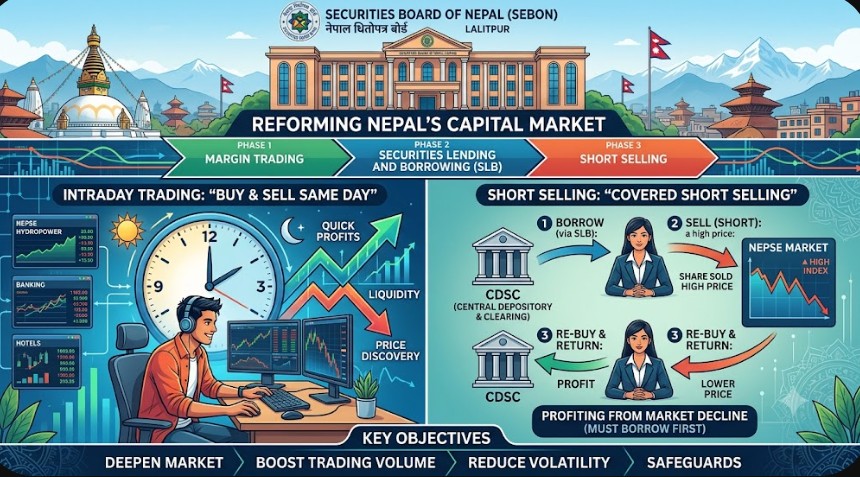
The Securities Board of Nepal (SEBON) has accelerated preparations to modernize and diversify Nepal’s capital market. For the first time, SEBON has initiated a formal policy dialogue with academic experts from universities teaching finance and related subjects to discuss the introduction of modern financial instruments such as Margin Lending, Intraday Trading, Securities Lending & Borrowing (SLB), and Short Selling.
The discussion was held at the SEBON office in Lalitpur under the leadership of SEBON Chairman Dr. Gopal Prasad Bhatt. Academic experts were invited to provide feedback and recommendations on various consultation papers and policy papers prepared by the regulator.
New Financial Instruments Under Discussion in Nepal
SEBON is studying the possibility of introducing international capital market practices to Nepal to expand trading opportunities and improve the overall depth and liquidity of the market.
The major financial instruments discussed include:
1. Margin Lending
Margin Lending allows investors to use their existing securities as collateral to obtain additional funds for investment in the stock market.
The system can increase investors’ purchasing power and potentially improve market liquidity. However, because margin trading involves leverage, investors can also face higher losses if stock prices move against their positions.
2. Intraday Trading
Intraday Trading allows investors and traders to buy and sell securities within the same trading day.
The introduction of intraday trading in Nepal could create new opportunities for short-term traders while potentially increasing trading volume, market liquidity and price discovery.
However, successful intraday trading requires strong knowledge of technical analysis, risk management, trading psychology and market discipline.
3. Securities Lending & Borrowing (SLB)
Securities Lending & Borrowing (SLB) allows securities holders to lend their shares to other market participants for a specified period and under defined conditions.
SLB can improve the utilization of securities and provide the infrastructure required for advanced trading mechanisms, including short selling.
A well-regulated SLB market could also contribute to greater market efficiency and liquidity.
4. Short Selling
Short Selling is an advanced trading mechanism where an investor borrows securities and sells them with the expectation that the market price will decline.
If the price falls, the trader can potentially buy the securities back at a lower price and return them to the lender.
Short selling can improve market liquidity and price discovery, but it also carries significant risks. Therefore, proper regulation, margin requirements, risk controls and investor protection mechanisms are essential.
Financial Innovation Must Be Supported by Financial Literacy
Academic experts welcomed SEBON’s initiative but emphasized that introducing advanced financial instruments should go hand in hand with improving financial literacy and investor education.
Margin Lending, Intraday Trading and Short Selling are more complex than traditional share investing and can expose investors to higher levels of financial risk.
Before implementing these instruments, Nepal needs adequate preparation in areas such as:
- Investor Education
- Financial Literacy
- Risk Management
- Market Infrastructure
- Regulatory Framework
- Trading Technology
- Investor Protection
- Market Surveillance
A strong regulatory and educational framework will be essential for the sustainable development of Nepal’s capital market.
SEBON’s First Formal Policy Dialogue with Academic Experts
The involvement of university professors and academic experts in capital market policy development is an important development for Nepal.
Collaboration between academic research, financial theory and practical market experience can help regulators develop more evidence-based and effective policies.
Academic participation can also help identify potential risks and opportunities before new financial products are introduced into the market.
SEBON has indicated that collaboration with academic institutions and financial market experts will continue in the future.
How Could These Instruments Change Nepal’s Stock Market?
If introduced with appropriate regulations and infrastructure, these financial instruments could significantly change the structure of Nepal’s capital market.
Potential benefits include:
Higher Liquidity → Greater Market Depth → Better Price Discovery → More Trading Opportunities
The introduction of these instruments could gradually transform Nepal’s stock market from an equity-focused market into a more diversified and multi-instrument capital market.
However, new financial products also create new risks. Effective risk management, investor protection, market surveillance and financial education will therefore be critical.
Importance of Share Market Training in Nepal
As interest in Share Market Training Nepal, Stock Market Training Nepal, NEPSE Analysis Course Nepal and Stock Market Investment Training continues to grow, understanding advanced trading concepts will become increasingly important for Nepalese investors and traders.
Investors looking to participate in modern trading markets should develop knowledge of:
- NEPSE Technical Analysis
- Candlestick Patterns
- Support and Resistance
- Pivot Points
- Moving Averages
- RSI and MACD
- Risk Management
- Trading Psychology
- Portfolio Management
- Intraday Trading
- Margin Trading
- Short Selling
- Securities Lending & Borrowing
For anyone looking to build a stronger foundation in the Nepalese stock market, Sarbaguna Trading School focuses on practical market education, NEPSE analysis and trading knowledge.
What This Means for Nepalese Investors
The proposed introduction of Margin Lending, Intraday Trading, SLB and Short Selling could create new opportunities for Nepalese investors and traders.
At the same time, investors should understand that advanced financial instruments can increase both profit potential and risk. Education, disciplined trading and proper risk management will become increasingly important as Nepal’s capital market evolves.
Conclusion
SEBON’s initiative to study and potentially introduce Margin Lending, Intraday Trading, Securities Lending & Borrowing (SLB) and Short Selling represents an important step toward modernizing Nepal’s capital market.
The success of these instruments will depend not only on policy approval but also on strong regulation, technology, investor education, financial literacy, risk management and market infrastructure.
If implemented after comprehensive research, consultation and adequate preparation, these instruments could increase market liquidity, improve price discovery and expand trading opportunities, helping Nepal move toward a more modern and diversified capital market.


Leave a Comments
Comments
Related post
Popular




Recent Post

No comments yet.