

Share Market in Nepal for Beginners | NEPSE Guide & Training
Share Market in Nepal for Beginners: Complete Guide to NEPSE, Investing and Trading
If you are new to the share market in Nepal, you may have many questions:
- What is the Nepal share market?
- How does NEPSE work?
- How can a beginner start investing in shares?
- What is the difference between an IPO and secondary-market trading?
- How do fundamental and technical analysis work?
- How can you reduce risk while investing or trading?
The Nepalese stock market can provide opportunities for long-term wealth creation and active trading, but it is not a shortcut to guaranteed profits. The first step for every beginner should be financial education, research and disciplined decision-making.
This complete guide explains the Nepal share market for beginners, including NEPSE, IPOs, Demat accounts, broker accounts, fundamental analysis, technical analysis, trading psychology and risk management.
If you want structured practical education, you can also explore Share Market Training in Nepal from Sarbaguna Investment.
What Is the Share Market in Nepal?
The share market is a marketplace where investors can buy and sell ownership interests in publicly listed companies.
When you purchase shares of a company, you become a shareholder. Depending on the type and quantity of shares you own, you may have rights associated with ownership, such as receiving dividends when declared by the company.
In Nepal, the secondary share market is commonly associated with the Nepal Stock Exchange (NEPSE).
For a beginner, it is important to understand that buying a stock means buying an ownership interest in a business—not simply purchasing a number that moves up and down on a trading screen.
How Does the Nepal Stock Market Work?
The Nepalese share market can broadly be understood through two markets:
1. Primary Market
The primary market is where securities are offered to investors for the first time.
One of the most familiar examples is an Initial Public Offering (IPO).
When a company issues shares to the public through an IPO, eligible investors can apply for those shares according to the applicable rules and procedures.
2. Secondary Market
The secondary market is where investors trade securities that have already been issued.
For example, after a company's shares are listed on NEPSE, investors can buy and sell those shares through the secondary market using a licensed broker and trading system.
This is where most daily stock-market price movements take place.
What Is NEPSE?
NEPSE stands for Nepal Stock Exchange.
It is Nepal's organized stock exchange where listed securities are traded in the secondary market.
For anyone learning the share market in Nepal, understanding NEPSE is essential.
Beginners should become familiar with concepts such as:
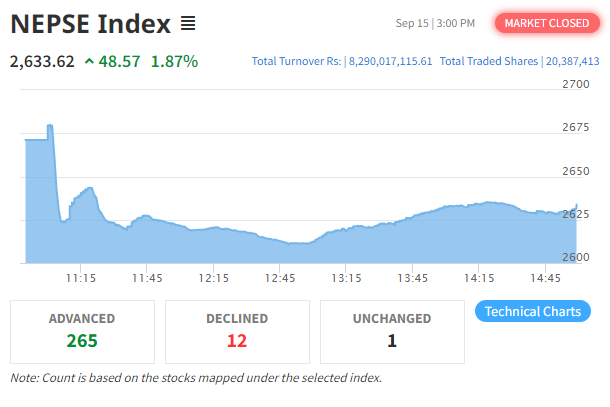
- NEPSE Index
- Sector indices
- Listed companies
- Daily turnover
- Market capitalization
- Trading volume
- Price movement
- Market breadth
- Support and resistance
- Trading activity
Instead of focusing only on whether the NEPSE Index is rising or falling, investors should learn how to interpret the underlying market data.
What Does a Beginner Need to Start Investing in Nepal?
Before entering the market, investors generally need the appropriate accounts and access to the investment infrastructure.
A beginner should understand the purpose of:
Bank Account
A bank account is required for handling money related to your investment activities.
Demat Account
A Demat account electronically holds your securities.
Mero Share
Mero Share is widely used by Nepalese investors for activities such as IPO applications and viewing their holdings and related information.
Broker Account
A licensed stock broker provides access to secondary-market trading.
Before investing real money, beginners should understand how these systems work and how orders are placed and settled.
How Are Share Prices Determined?
One of the most important concepts in stock-market education is demand and supply.
When demand for a particular stock increases relative to available supply, its price may rise. Conversely, when selling pressure becomes stronger than buying demand, the price may decline.
However, stock prices are influenced by many factors, including:
- Company performance
- Earnings
- Interest rates
- Liquidity
- Investor expectations
- Sector conditions
- Economic developments
- Government policies
- Market sentiment
- Corporate announcements
- Technical factors
This is why investors should avoid making decisions based solely on social-media discussions or rumors.
Fundamental Analysis: Understanding the Business
Fundamental analysis focuses on the financial and economic factors that can influence a company's value.
A fundamental investor attempts to understand the quality, profitability, financial strength and future potential of a business.
Some important areas include:
Earnings Per Share (EPS)
EPS helps investors understand the earnings attributable to each share.
Price-to-Earnings Ratio (P/E)
The P/E ratio compares a company's market price with its earnings per share.
Book Value
Book value can provide insight into the accounting value of a company's net assets.
Revenue and Profit Growth
Consistent revenue and earnings growth can be important indicators when evaluating a company.
Dividend History
Investors may also consider a company's dividend record, payout capacity and future dividend potential.
Financial Statements
A serious investor should learn how to read:
- Income statements
- Balance sheets
- Cash-flow statements
- Notes to financial statements
Fundamental analysis is particularly useful for investors who are building a long-term portfolio.
Technical Analysis: Understanding Price and Volume
Technical analysis studies historical price and volume data to identify market trends, patterns and potential trading setups.
Technical analysis does not guarantee future prices. Instead, it provides a framework for analyzing market behavior and managing trading decisions.
Important technical-analysis concepts include:
- Candlestick patterns
- Support and resistance
- Trendlines
- Moving averages
- RSI
- MACD
- Volume analysis
- Breakouts
- Chart patterns
- Momentum
- Price action
For beginners, technical analysis should be learned systematically rather than by memorizing individual indicators.
Learn more about NEPSE Analysis and Technical Analysis Training with Sarbaguna.
Fundamental Analysis vs Technical Analysis
Both approaches can be useful, but they answer different questions.
| Fundamental Analysis | Technical Analysis |
|---|---|
| Focuses on business quality | Focuses on price behavior |
| Studies financial statements | Studies charts and market data |
| Useful for valuation | Useful for timing and trade setups |
| Considers earnings and financial health | Considers trends, momentum and volume |
| Often used for longer-term investing | Often used for trading and timing |
Many experienced market participants use a combination of both approaches.
For example, an investor might use fundamental analysis to identify financially attractive companies and technical analysis to assess entry levels, market momentum and risk.
Investing vs Trading: What Is the Difference?
A common mistake among beginners is assuming that investing and trading are exactly the same.
They are not.
Investing
Investors generally focus on the long-term potential of a company and may hold shares for an extended period.
Their analysis may emphasize:
- Business quality
- Earnings growth
- Valuation
- Competitive position
- Management
- Dividends
- Long-term economic conditions
Trading
Traders generally focus more on shorter-term price movements.
Their analysis may emphasize:
- Price action
- Momentum
- Volume
- Breakouts
- Support and resistance
- Market sentiment
- Entry and exit levels
- Risk-to-reward ratios
Neither approach automatically guarantees success.
The right approach depends on your financial objectives, risk tolerance, time availability and knowledge.
Why Risk Management Matters in the Nepal Share Market
One of the most important lessons for a new investor is that protecting capital is as important as seeking returns.
Even a fundamentally strong company can experience price declines.
Similarly, a technically attractive trading setup can fail.
Beginners should therefore consider:
- Position sizing
- Diversification
- Stop-loss planning
- Risk-to-reward ratios
- Portfolio allocation
- Investment horizon
- Emergency cash requirements
- Personal risk tolerance
Never invest money you cannot afford to lose simply because someone claims that a stock is going to rise.
Avoid Blindly Following Stock Tips
Social media has made stock-market information easier to access, but it has also increased the amount of speculation and unverified information available to investors.
Before buying a stock, ask:
- Why am I buying this company?
- What is my investment or trading timeframe?
- What does the company actually do?
- Have I checked its financial condition?
- What is the current valuation?
- What does the chart indicate?
- What is my downside risk?
- When would I exit if my analysis proves wrong?
Developing your own decision-making process is far more valuable than constantly searching for the next "hot stock."
Common Mistakes Made by Share Market Beginners in Nepal
1. Buying Because Someone Recommended It
A stock tip is not an investment strategy.
2. Investing Without Understanding the Company
Do not buy a company simply because its price is rising.
3. Ignoring Risk Management
A good opportunity can still become a bad trade if the position is too large.
4. Chasing Rapid Price Increases
Buying after a large price increase purely because of fear of missing out can increase risk.
5. Using Borrowed Money Without Understanding the Risk
Leverage can magnify both gains and losses.
6. Trading Without a Plan
Know your entry, risk level, target and exit conditions before taking a trade.
7. Expecting Guaranteed Returns
No legitimate stock-market education program can guarantee profits.
How Can Beginners Learn the Share Market in Nepal?
The best way to learn is to progress step by step.
Step 1: Learn the Basics
Understand shares, IPOs, NEPSE, brokers, Demat, Mero Share and basic market terminology.
Step 2: Learn Fundamental Analysis
Study financial statements, EPS, P/E, book value, profitability, debt and business performance.
Step 3: Learn Technical Analysis
Understand charts, candlesticks, trends, support, resistance, volume and indicators.
Step 4: Learn Risk Management
Learn how to protect your capital before focusing on maximizing returns.
Step 5: Practice
Analyze historical charts and company financials before committing significant capital.
Step 6: Develop Your Own Strategy
Your investment decisions should be based on your objectives, risk tolerance and analysis—not someone else's portfolio.
Share Market Training in Nepal
If you are searching for Share Market Training Nepal, NEPSE training, stock market classes in Kathmandu, or practical technical analysis training, structured education can help you build a stronger foundation.
Sarbaguna Trading School provides Nepal-focused education covering areas such as:
- Share market basics
- NEPSE analysis
- Technical analysis
- Fundamental analysis
- Candlestick patterns
- Support and resistance
- Trading strategies
- Risk management
- Investment planning
- Market psychology
Sarbaguna's training is designed for both beginners and people who already have experience in the Nepalese stock market.
You can learn more through Sarbaguna Share Market Training Nepal or explore the Share Market Training in Kathmandu program.
Learn From Deep Thapa at Sarbaguna
If you want practical guidance while learning the Nepalese stock market, contact Deep Thapa at Sarbaguna.
Call / WhatsApp: 9849290806
Whether you are starting from zero or want to improve your technical and fundamental analysis skills, the goal should be to develop the ability to analyze the market independently.
Learn. Analyze. Plan. Manage Risk. Execute. Review.
Visit Sarbaguna.com for additional stock-market education, NEPSE analysis and training resources.
Frequently Asked Questions About the Share Market in Nepal
What is the share market in Nepal?
The share market in Nepal is the marketplace where securities of publicly listed companies are issued and traded. NEPSE is Nepal's stock exchange for secondary-market trading.
How can a beginner start investing in Nepal?
A beginner should first learn the basics, establish the required financial and securities accounts, understand how the trading system works and develop an investment plan before committing significant capital.
What is NEPSE?
NEPSE stands for Nepal Stock Exchange. It is Nepal's organized stock exchange where listed securities are traded.
What is the difference between an IPO and secondary-market trading?
An IPO is an initial public offering through which securities are offered to the public. Secondary-market trading occurs when investors subsequently buy and sell listed securities.
What is fundamental analysis?
Fundamental analysis evaluates a company's financial performance, valuation, business prospects and financial health to help investors make investment decisions.
What is technical analysis?
Technical analysis studies historical price and volume information to identify trends, patterns, momentum and potential trading opportunities.
Is the Nepal share market safe for beginners?
Investing in shares involves risk. Beginners should understand volatility, conduct research, diversify appropriately and use risk-management techniques rather than expecting guaranteed returns.
Can I learn share market trading in Nepal?
Yes. Beginners can learn through structured courses, educational resources, practical chart analysis and supervised market-learning programs. Sarbaguna offers Share Market Training in Nepal covering beginner and advanced concepts.
Where can I get share market training in Kathmandu?
Sarbaguna provides share market training in Kathmandu covering stock-market fundamentals, technical analysis, fundamental analysis, trading strategies and risk management.
Who can I contact for Sarbaguna share market training?
You can contact Deep Thapa at 9849290806 by call or WhatsApp for course information, schedules and enrollment details.
Final Thoughts
Learning the share market in Nepal should be a process rather than a race.
The objective should not be to find a guaranteed winning stock. Instead, investors should develop the ability to understand businesses, interpret financial information, analyze price behavior, manage risk and make independent decisions.
Whether you are interested in long-term investing, IPOs, NEPSE trading or technical analysis, a strong foundation can help you approach the market with greater discipline and confidence.
Do your research. Manage your risk. Build your own strategy.
For practical Share Market Training Nepal, contact:
Deep Thapa – Sarbaguna Trading School
Call / WhatsApp: 9849290806
Website: Sarbaguna.com


Leave a Comments
Comments
Popular






Recent Post
No comments yet.