

Forex Trading in Nepal: Complete Guide
Forex Trading in Nepal: Complete Beginner’s Guide to Foreign Exchange Trading
Forex trading, short for foreign exchange trading, is the global marketplace where currencies are bought and sold against each other. Unlike the stock market, where investors purchase shares of companies, forex traders speculate on changes in the value of one currency relative to another.
For beginners, understanding what forex is, how currency pairs work, leverage, trading strategies, risk management, and market psychology is essential before considering any trading activity.
For Nepalese learners interested in financial markets, forex education can also complement knowledge gained through share market training in Nepal, technical analysis, fundamental analysis, and broader investment education.
Important: Forex trading involves significant risk. Regulations, permitted products, brokers, and access to foreign-exchange trading can differ by country. Nepal-based readers should independently verify the applicable rules and use only legally permitted financial services.
What Is Forex?
Forex, or foreign exchange, is the international market for buying and selling currencies.
Currencies are always traded in pairs. For example:
- EUR/USD
- GBP/USD
- USD/JPY
- AUD/USD
- USD/CAD
When trading a currency pair, you are simultaneously buying one currency and selling another.
For example, if EUR/USD is quoted at 1.10, the basic interpretation is that one euro is worth 1.10 U.S. dollars.
The global forex market is decentralized rather than operating through one central stock exchange. Transactions take place electronically through a worldwide network of banks, financial institutions, businesses, brokers and other participants.
Why Is Forex Trading Important?
Foreign exchange is fundamental to international commerce.
Businesses need currencies when importing and exporting goods, investors exchange currencies when investing internationally, travelers need foreign currency, and financial institutions use the market to manage currency exposure.
Forex activity is also influenced by major economic and geopolitical developments.
Factors that can affect currency values include:
- Interest rates
- Inflation
- Economic growth
- Employment data
- Central-bank policy
- Government policy
- Political developments
- International trade
- Market sentiment
- Geopolitical events
Understanding these drivers is an important part of forex fundamental analysis.
How Does Forex Trading Work?
Forex trading involves one currency being exchanged for another.
Suppose a trader believes the U.S. dollar will strengthen against another currency. The trader may establish a position designed to benefit if the exchange rate moves in the expected direction.
If the market moves against the trader, however, the position can produce a loss.
This is why successful trading is not simply about predicting whether a currency will rise or fall.
A disciplined approach combines:
Market Analysis + Trading Strategy + Risk Management + Psychology + Execution
Understanding Currency Pairs
One of the first concepts beginners should learn is the structure of a currency pair.
A currency pair contains:
Base Currency / Quote Currency
For example:
EUR/USD
EUR is the base currency, while USD is the quote currency.
If EUR/USD is 1.10, it means one euro is valued at 1.10 U.S. dollars.
Currency pairs are commonly grouped into three categories.
1. Major Currency Pairs
Major pairs generally involve highly traded currencies and often include the U.S. dollar.
Examples include:
- EUR/USD
- GBP/USD
- USD/JPY
- USD/CHF
- AUD/USD
- USD/CAD
2. Minor Currency Pairs
These involve major currencies but do not include USD.
Examples include:
- EUR/GBP
- EUR/JPY
- GBP/JPY
3. Exotic Currency Pairs
Exotic pairs generally combine a major currency with a currency from a smaller or emerging economy.
These pairs can have different liquidity, spreads and risk characteristics.
What Moves Forex Prices?
Currency prices constantly change because the market continuously evaluates economic and financial information.
Interest Rates
Central-bank interest-rate decisions can strongly influence currencies.
Higher or lower interest-rate expectations can change international capital flows and affect demand for a currency.
Inflation
Changes in inflation expectations can influence central-bank policy and currency valuations.
Economic Growth
Strong economic data can increase confidence in a country's economy, while weak economic conditions may create pressure on its currency.
Employment Data
Employment reports are closely followed because they provide information about economic health and potential monetary-policy changes.
Political and Geopolitical Events
Elections, conflicts, trade disputes and policy changes can create significant volatility in currency markets.
Market Sentiment
Sometimes currencies move because traders become more optimistic or pessimistic about global economic conditions.
This is why forex traders often combine fundamental analysis and technical analysis.
What Are the Different Forex Markets?
Foreign exchange transactions can be structured in several ways.
Spot Forex
Spot transactions involve exchanging currencies based on the current market rate, subject to the applicable settlement arrangements.
Forward Contracts
A forward agreement allows two parties to establish terms for exchanging currencies at a future date.
Futures
Currency futures are standardized contracts traded through organized exchanges.
Options
Currency options provide a right, but generally not an obligation, to buy or sell a currency at specified terms.
Beginners should understand that these instruments have different characteristics and risks.
Who Participates in the Forex Market?
The forex ecosystem includes many different participants.
Commercial Banks
Banks facilitate currency transactions and provide significant liquidity.
Central Banks
Central banks influence monetary conditions and can have major effects on currency markets through interest-rate and policy decisions.
Multinational Companies
Companies operating across borders may need foreign currencies for international business.
Investment Funds
Funds may trade currencies for investment, hedging or portfolio-management purposes.
Retail Traders
Individual traders can access certain forex products through brokers, depending on the laws and regulations applicable to their location.
How to Start Learning Forex Trading
Beginners should focus on education before attempting to trade.
Step 1: Learn Forex Basics
Understand:
- Currency pairs
- Bid and ask prices
- Spread
- Pip
- Lot size
- Leverage
- Margin
- Stop-loss
- Take-profit
- Risk/reward ratio
Step 2: Learn Technical Analysis
Technical analysis studies price and volume data to identify potential market structures and trading opportunities.
Important topics include:
- Support and resistance
- Trendlines
- Chart patterns
- Candlestick patterns
- Moving averages
- RSI
- MACD
- Volume
- Price action
- Market structure
The same analytical concepts can also be useful when studying the NEPSE stock market.
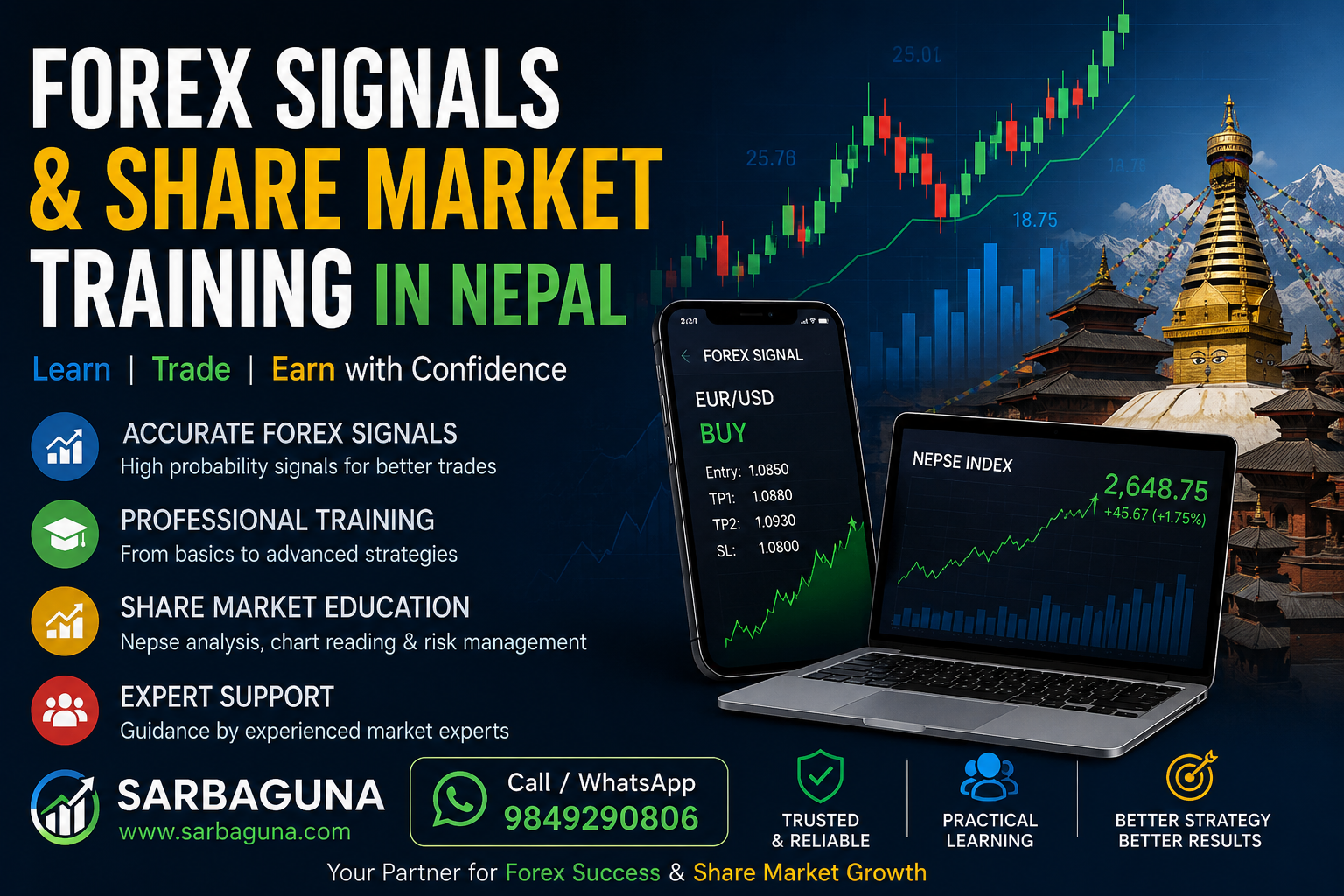
For learners interested in both markets, Sarbaguna provides practical education covering technical analysis, fundamental analysis, stock-market concepts and trading skills.
Step 3: Learn Fundamental Analysis
Forex traders should understand how economic developments influence currencies.
Study:
- Central-bank decisions
- Interest rates
- Inflation
- GDP
- Employment
- Trade data
- Economic calendars
- Government policy
Step 4: Practice Before Taking Significant Risk
A demo environment can help beginners understand how trading platforms work and test a strategy without immediately putting substantial capital at risk.
Step 5: Develop a Trading Plan
A trading plan should define:
- Entry conditions
- Exit conditions
- Stop-loss rules
- Position size
- Maximum acceptable loss
- Trading timeframe
- Markets to trade
- Conditions for avoiding trades
What Is Leverage in Forex?
Leverage allows a trader to control a position larger than the amount of capital deposited as margin.
Although leverage can increase potential returns, it can also magnify losses.
For example, a small movement against a highly leveraged position can result in a substantial loss relative to the trader's capital.
Therefore:
Higher leverage does not mean lower risk.
For beginners, understanding leverage and position sizing is one of the most important aspects of forex risk management.
Forex Risk Management
Many beginners concentrate heavily on finding the "perfect" entry point.
Professional trading education should place equal or greater emphasis on risk management.
Important principles include:
Use Stop-Loss Orders
A stop-loss can help define the maximum acceptable loss on a trade, although execution can vary in fast-moving markets.
Control Position Size
Avoid risking an excessive percentage of your trading capital on one idea.
Understand Risk/Reward
A strategy should consider both the potential reward and potential loss.
Avoid Overtrading
More trades do not automatically mean better results.
Don't Chase the Market
Entering after a large move simply because of fear of missing out can produce poor risk/reward conditions.
Keep a Trading Journal
Recording trades can help identify recurring mistakes and improve discipline.
Forex Trading Psychology
Trading decisions are influenced by emotions.
Common psychological problems include:
- Fear
- Greed
- Revenge trading
- Fear of missing out
- Overconfidence
- Impatience
- Loss aversion
A trader can have a technically sound strategy and still lose money through poor discipline.
The objective is not to eliminate emotions completely. Instead, traders should build systems that reduce impulsive decision-making.
Forex Trading vs Share Market Investing
Forex and stock-market investing are different financial activities.
| Forex Trading | Share Market Investing |
|---|---|
| Trades currencies | Invests in company shares |
| Currency pairs are used | Individual stocks are purchased |
| Global market | Usually exchange-specific |
| Often highly leveraged | Leverage varies by market/product |
| Currency movements are central | Company performance is central |
| Macroeconomic factors are important | Company and sector fundamentals are important |
For Nepalese investors, understanding the local NEPSE share market is particularly important before investing in Nepalese listed companies.
If your primary interest is the Nepal stock market, you can explore Share Market Training in Nepal and Sarbaguna's practical NEPSE education programs.
Why Learn Technical Analysis?
Technical analysis is relevant across several financial markets because it focuses on price behavior and market structure.
A structured technical-analysis course can help learners understand:
- Trend identification
- Support and resistance
- Chart patterns
- Candlestick analysis
- Momentum
- Volume
- Market psychology
- Entry and exit planning
- Risk management
For Nepalese learners, these skills can be applied to NEPSE analysis and stock-market education, subject to the characteristics of the local market.
Sarbaguna's NEPSE Analysis Course focuses on price action, trends, momentum, volatility, volume interpretation, trade planning and risk management.
Forex Trading Education in Nepal
Anyone searching for forex trading courses in Nepal, forex trading training in Kathmandu, or broader financial-market education should prioritize learning rather than promises of guaranteed profits.
A good training program should explain:
- Forex market structure
- Currency pairs
- Technical analysis
- Fundamental analysis
- Risk management
- Trading psychology
- Trading strategies
- Position sizing
- Practical chart analysis
Sarbaguna also offers forex-focused education covering market analysis, trading strategies, risk management and trading psychology.
Share Market Training Nepal: Learn Beyond Stock Tips
Forex education can be part of a broader understanding of financial markets.
For people interested in the Nepal share market, proper education should cover:
- NEPSE basics
- DEMAT account concepts
- Mero Share
- TMS
- IPOs
- Secondary-market trading
- Fundamental analysis
- Technical analysis
- Financial statements
- Portfolio management
- Risk management
- Trading psychology
Sarbaguna's share-market training is designed around practical NEPSE education for beginners, investors and traders rather than simply following stock tips.
Is Forex Trading Profitable?
Forex trading can generate profits for some participants, but there is no guaranteed return.
Market volatility creates both opportunities and risks.
Results depend on numerous factors, including:
- Strategy
- Risk management
- Capital
- Trading costs
- Market conditions
- Discipline
- Experience
- Psychology
- Regulatory and broker conditions
Anyone promising guaranteed forex profits should be approached with extreme caution.
Common Forex Trading Mistakes Beginners Make
1. Trading Without Education
Entering the market without understanding basic terminology and risk can be expensive.
2. Using Excessive Leverage
Leverage can amplify losses as well as gains.
3. Trading Without a Stop-Loss Plan
Without predefined risk parameters, losses can become difficult to control.
4. Following Random Signals
Blindly following social-media signals does not build independent trading ability.
5. Revenge Trading
Trying to immediately recover a previous loss often leads to even greater risk.
6. Overtrading
Taking unnecessary positions can increase costs and expose capital to avoidable risk.
7. Ignoring Regulations
Before accessing any financial product, traders should understand the laws and regulatory requirements applicable in their jurisdiction.
Frequently Asked Questions About Forex Trading
What is forex trading?
Forex trading is the buying and selling of currencies in the foreign exchange market. Currencies are traded in pairs, with traders attempting to benefit from changes in exchange rates.
Is forex trading the same as stock trading?
No. Forex trading involves currencies, while stock trading involves ownership interests in companies. The markets have different structures, participants and risks.
Can beginners learn forex trading?
Yes. Beginners can learn forex concepts through structured education, market analysis, demo practice and risk-management training before considering real-money trading.
What is a currency pair?
A currency pair compares the value of one currency against another, such as EUR/USD. The first currency is the base currency and the second is the quote currency.
What is leverage in forex?
Leverage allows traders to control a larger position using a smaller amount of capital as margin. It can increase both potential gains and potential losses.
Is forex trading risky?
Yes. Forex trading can involve substantial risk because currency prices can move rapidly and leverage can magnify losses.
How can I learn technical analysis in Nepal?
You can learn technical analysis through structured training covering price action, support and resistance, chart patterns, indicators, market structure and risk management. Sarbaguna offers NEPSE and technical-analysis training in Nepal for beginners and traders.
Does Sarbaguna provide share market training in Nepal?
Yes. Sarbaguna provides practical share market training in Nepal, including education related to NEPSE, technical analysis, fundamental analysis, trading and investment concepts.
How can I contact Sarbaguna for trading training?
For course information and enrollment, contact Deep Thapa at 9849290806 by call or WhatsApp.
Learn Forex, NEPSE and Financial Markets with Sarbaguna
Financial-market education should focus on building knowledge, discipline and independent decision-making—not on unrealistic promises of quick profits.
Whether your interest is forex trading, NEPSE analysis, stock market investing, technical analysis or fundamental analysis, building a strong foundation can help you make better-informed decisions.
Interested in Learning?
Deep Thapa – Sarbaguna
📞 Call / WhatsApp: 9849290806
Explore Share Market Training Nepal for practical stock-market and NEPSE education.
Disclaimer: This article is for educational and informational purposes only and should not be considered financial, investment, legal or regulatory advice. Forex and other financial-market activities can involve substantial risk. Always verify applicable Nepalese laws, regulations and authorized financial-service providers before participating.
Suggested Internal Links:
- Share Market Training Nepal → Sarbaguna Trading School
- NEPSE Analysis Course → NEPSE Analysis Course Nepal
- Forex Trading Course Nepal → Forex Trading Course in Nepal
- Investment Training Nepal → Investment Training Nepal Stock Market


Leave a Comments
Comments
Popular





Recent Post
No comments yet.