

Nepal Investment Confidence: Finance Minister’s Plan for Economic Recovery
Nepal’s Finance Minister Outlines Plan to Rebuild Investor Confidence and Revive Private Investment
Nepal Needs Investor Confidence to Revive Investment and Economic Activity
Nepal’s Finance Minister has emphasized that restoring investor confidence should be one of the government’s key priorities for reviving private investment, industrial expansion and broader economic activity.
The Finance Minister’s recent remarks offer an important perspective on why businesses and investors may remain cautious even when financial resources are available within the banking system.
For entrepreneurs, having access to bank financing is only one part of an investment decision. What matters more is whether the overall business environment will remain predictable and supportive over the next several years.
For investors in the Nepal stock market and NEPSE, the same principle is important: investment decisions are ultimately driven by expectations about future economic growth, corporate earnings, policies and market confidence.
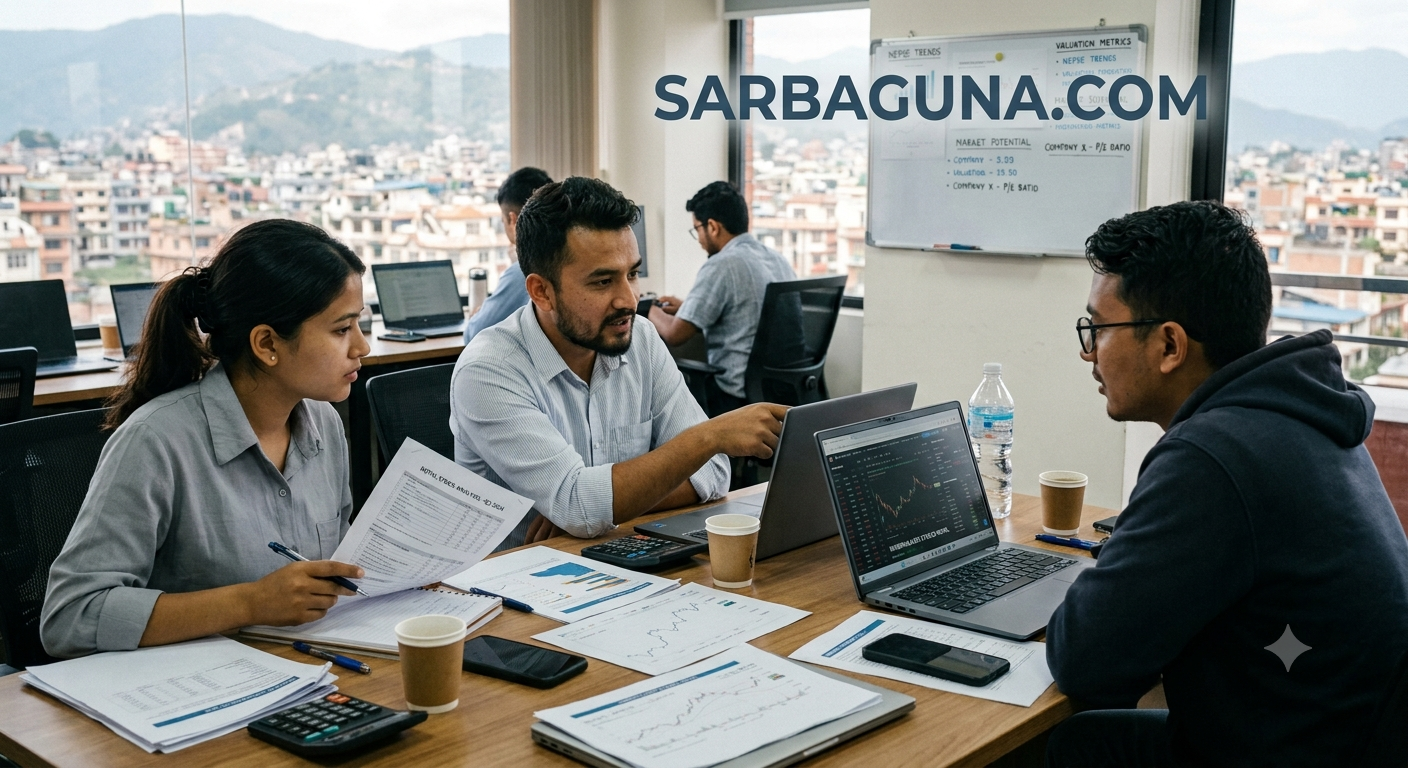
Those interested in understanding the fundamentals of investing can also explore [share market training in Nepal] and practical investment education through Sarbaguna.com.
Entrepreneurs Look Beyond Bank Liquidity
An entrepreneur does not decide whether to invest simply by asking whether money is available at a bank.
Instead, an entrepreneur considers a much broader set of questions:
- What will the policy environment look like over the next five years?
- Will government policies remain predictable?
- How will tax administration affect the business?
- Will investments and businesses remain secure?
- How strong will overall market demand be?
- Can a newly expanded industry operate profitably?
- Will the government act as a problem-solving partner or create additional uncertainty?
These questions demonstrate why investment is fundamentally a decision based on expectations about the future.
When businesses do not have confidence in the future, they are more likely to delay expansion, hiring and capital expenditure.
Why Investor Confidence Matters for Nepal’s Economy
Confidence plays a central role in economic activity.
Even when banks have sufficient liquidity, businesses may choose a “wait-and-see” approach if they are uncertain about future policies, demand or regulatory conditions.
Similarly, an industry may have the capacity to increase production but postpone expansion because management is uncertain about whether additional investment will generate adequate returns.
This creates a cycle in which:
Low confidence → delayed investment → slower expansion → weaker economic activity → lower business confidence
Breaking this cycle requires policies that provide greater certainty and encourage businesses to make long-term decisions.
For the Nepal stock market, confidence is equally significant. Expectations about economic growth, interest rates, corporate profitability, government policies and liquidity can influence investor sentiment and NEPSE trends.
Rebuilding Expectations and Trust Is the Priority
According to the Finance Minister’s message, the government’s immediate challenge is not simply to increase the availability of money but to rebuild expectations and trust.
This is particularly important because investment decisions are made with a long-term horizon.
A business investing today may have to operate under the same regulatory, tax and economic environment for many years. Therefore, investors need confidence that policies will be reasonably predictable and that legitimate businesses will receive a fair opportunity to compete.
This principle also applies to individuals participating in Nepal’s capital market.
A successful investor should not make decisions solely because the NEPSE index is rising or falling. Understanding economic conditions, company fundamentals, valuation, technical trends and risk management is equally important.
Government’s Role: Create an Environment Where Businesses Can Grow
One of the most important messages in the Finance Minister’s statement is the changing relationship between the government and the private sector.
The government does not necessarily need to operate businesses itself.
Instead, its responsibility should be to create an environment in which businesses can operate, compete and expand.
That includes:
- Predictable economic policies
- Fair taxation and tax administration
- Effective regulation
- Protection of legitimate investment
- Fair competition
- Reduced bureaucratic uncertainty
- Faster problem resolution
- Encouragement of productive entrepreneurship
The government should also distinguish between productive entrepreneurship and rent-seeking activities.
While unfair advantages and rent-seeking should be discouraged, productive businesses that create employment, investment, production and economic value should receive an environment that allows them to grow.
Government and Private Sector Need Stronger Partnership
The Finance Minister has also highlighted the importance of continuous dialogue between the government and the private sector.
The government has initiated discussions with:
- Industrialists and entrepreneurs
- Business leaders
- Bank CEOs
- Large taxpayers
- Regulatory authorities
Such communication can help identify practical obstacles faced by businesses and improve policymaking.
For Nepal’s economy, the quality of this government–private-sector relationship could have a significant impact on investment, employment, production and economic growth.
What Does This Mean for Nepal’s Share Market?
The message is also relevant for Nepal’s share market investors.
The stock market reflects expectations about the future. When investors expect stronger economic growth, improved corporate earnings, stable policies and better liquidity, market sentiment can improve.
However, investors should avoid interpreting every government announcement as an immediate buy or sell signal.
Instead, investors should consider:
Policy → Economy → Business earnings → Valuation → Market trend
For example, if economic reforms successfully encourage private investment and industrial activity, companies in banking, insurance, hydropower, manufacturing, hotels and other sectors could potentially benefit over time.
However, the impact will vary from company to company. Investors should therefore combine fundamental analysis, technical analysis and risk management before making investment decisions.
Why Share Market Education Matters in Nepal
As Nepal’s capital market continues to develop, financial education is becoming increasingly important.
New investors often focus heavily on short-term price movements without fully understanding:
- Company financial statements
- Earnings and profitability
- PE ratio and valuation
- Support and resistance
- Market trends
- Risk management
- Portfolio diversification
- Dividend history
- Sector cycles
- Macroeconomic indicators
Learning these concepts can help investors make more informed decisions rather than relying entirely on rumors, social-media recommendations or short-term market sentiment.
If you are looking for share market training in Nepal, practical education covering both fundamental and technical aspects can be a useful starting point.
Deep Thapa – Share Market Training and Investment Education
For investors looking to improve their understanding of the Nepal stock market, NEPSE, technical analysis, fundamental analysis and investment strategies, share market education can help build a more disciplined approach.
Deep Thapa provides guidance and educational resources for people interested in understanding Nepal’s capital market.
📱 WhatsApp: 9849290806
Visit Sarbaguna.com for more Nepal stock market and investment-related content.
Key Takeaway
The Finance Minister’s message highlights a fundamental reality: investment does not depend only on the availability of money. It depends heavily on confidence in the future.
Businesses need predictable policies, fair competition, reasonable regulation and confidence that the government will work with the private sector to solve problems.
If these conditions improve, businesses may become more willing to expand capacity, invest capital and create employment.
For stock market investors, the same concept is worth remembering. Markets are driven by expectations about the future, not just by today’s numbers.
Therefore, rebuilding confidence could become an important foundation for Nepal’s broader economic recovery and potentially influence corporate earnings and capital-market sentiment over the longer term.
Frequently Asked Questions (FAQ)
1. Why is investor confidence important for Nepal?
Investor confidence encourages businesses to invest, expand operations, hire workers and increase production. Greater confidence can contribute to stronger economic activity and employment.
2. Does bank liquidity automatically increase investment?
No. Businesses consider many factors beyond financing availability, including government policies, taxes, market demand, regulations and expected future profitability.
3. What is the government’s role in private-sector development?
The government’s role is to create a predictable and competitive business environment, provide effective regulation, protect legitimate investment and help remove unnecessary barriers to entrepreneurship.
4. How can economic confidence affect the Nepal stock market?
Improved economic confidence can influence expectations regarding corporate earnings, investment and economic growth, potentially affecting investor sentiment and NEPSE. However, stock prices can also be affected by many other factors.
5. What should investors consider before investing in NEPSE?
Investors should consider company fundamentals, financial performance, valuation, sector outlook, technical trends, market conditions and their own risk tolerance rather than relying solely on short-term price movements.
6. Where can I learn share market investing in Nepal?
Investors can explore educational resources and share market training in Nepal through Sarbaguna.com and learn about fundamental analysis, technical analysis, NEPSE and investment risk management.
7. Who provides share market training and investment education?
Deep Thapa provides share market-related educational guidance and resources. For information, contact WhatsApp: 9849290806.
Tags


Leave a Comments
Comments
Popular




Recent Post
No comments yet.