

Nepal Stock Market Slowdown: Why Capital Gains Tax Fell 37.5% and What It Means for NEPSE Investors
Nepal Stock Market Slowdown: Why Capital Gains Tax Fell 37.5% and What It Means for NEPSE Investors
Nepal’s stock market has faced a challenging period, with the NEPSE index struggling to maintain sustained upward momentum and capital gains tax revenue falling sharply.
During the first 11 months of fiscal year 2025/26, Nepal’s government collected approximately Rs 9.54 billion in capital gains tax from share transactions, compared with Rs 15.27 billion during the same period of the previous fiscal year. That represents a decline of around 37.5%.
The decline is more than a government revenue story. Capital gains tax is linked to investors’ realized profits. When investors make fewer profitable trades, tax collections generally fall as well.
So, what is happening in Nepal’s stock market, why has investor profitability weakened, and what should NEPSE investors understand from this trend?
Nepal Stock Market Slowdown: The Bigger Picture
The Nepal Stock Exchange has spent much of fiscal year 2025/26 moving without a strong and sustained direction.
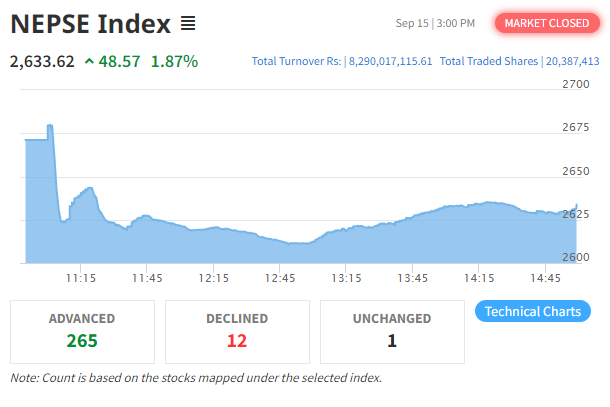
The NEPSE index remained around the 2,700-point area for extended periods, well below its previous record territory above 3,000 points. Political developments, corporate earnings, economic conditions, regulatory uncertainty and investor sentiment have all contributed to the market’s lack of momentum.
For investors, this creates a market environment where simply buying shares and waiting for prices to rise may not always be effective.
Instead, investors increasingly need to understand:
- Market cycles
- Company fundamentals
- Technical analysis
- Price action
- Support and resistance
- Trading volume
- Risk management
- Investor psychology
- Portfolio management
This is why structured Share Market Training Nepal can be valuable for people who want to understand NEPSE rather than simply follow market rumors or stock tips.
Capital Gains Tax Collection Falls to Rs 9.54 Billion
According to the reported data, Nepal collected Rs 9.54 billion in capital gains tax from share transactions during the first 11 months of FY 2025/26.
The comparable figure for the previous year was Rs 15.27 billion.
That means collections dropped by approximately 37.5% year over year.
Capital gains tax is generally collected when investors realize profits by selling shares. Therefore, the decline can provide an indication that investors collectively realized considerably lower profits than during the previous year.
However, tax revenue should not be interpreted as a standalone measure of total stock-market activity. Trading volume, realized gains, market prices and investor behavior all influence the final amount.
Why Did Capital Gains Tax Decline?
Several factors appear to have contributed to the decline.
1. Weak NEPSE Momentum
A major factor has been the inability of NEPSE to sustain a strong bullish trend.
When the broader market remains range-bound or falls, investors may find fewer opportunities to realize substantial gains.
2. Weaker Investor Profitability
Capital gains tax is associated with realized profits.
If investors sell shares with smaller gains—or sell at losses—tax collection can fall significantly.
The reported monthly data showed considerable volatility, with collection ranging from Rs 243.6 million to Rs 2.15 billion during different periods of the fiscal year.
3. Corporate Earnings
Listed-company earnings are another important component of investor confidence.
Weak or slower earnings growth can reduce expectations for dividends, profitability and future valuations.
When corporate fundamentals fail to provide a strong catalyst, investors may become more selective.
4. Political and Economic Uncertainty
Changes in government and broader economic uncertainty can affect investor confidence.
Investors often want greater visibility regarding monetary policy, regulation, taxation, lending conditions and economic growth before making larger commitments to the market.
5. Regulatory Uncertainty
Questions surrounding margin lending, institutional investors and other market regulations can influence trading behavior.
Greater clarity and consistency in regulation can help investors make decisions with more confidence.
Nepal Capital Gains Tax Changes in 2026
The 2026 national budget introduced an important change by making capital gains tax on share transactions the final withholding tax for individual investors.
This was intended to provide greater certainty regarding the tax treatment of share-market profits.
At the same time, the tax rates increased.
According to the reported budget changes:
- Long-term capital gains tax: increased from 5% to 7.5%
- Short-term capital gains tax: increased from 7.5% to 10%
The long-term rate applies to shares held for more than one year, while the short-term rate applies to shares sold within one year of purchase.
The change therefore created a mixed outcome for investors: greater tax certainty, but higher rates.
Did the New Tax Policy Revive NEPSE?
The immediate market response did not produce the strong revival that some investors had expected.
Trading activity and the NEPSE index remained under pressure following the budget, while the latest available capital-gains-tax figures also failed to show a meaningful improvement.
This suggests that taxation is only one part of the stock-market equation.
Investor confidence depends on a much broader combination of factors, including:
Economic growth + corporate earnings + liquidity + interest rates + regulation + investor sentiment + market expectations
A tax-policy change alone is unlikely to create a sustained bull market.
What Does Capital Gains Tax Tell Us About NEPSE?
One important lesson is that tax revenue from share trading can provide an indirect indication of market profitability.
Suppose trading volume is relatively high but investors are not making significant profits.
Capital gains tax may still remain weak.
That is because the tax is connected to realized gains rather than simply the number or value of shares traded.
Therefore, investors should look beyond turnover when evaluating the health of Nepal’s stock market.
Important indicators include:
- NEPSE trend
- Market breadth
- Trading volume
- Sector rotation
- Corporate earnings
- Dividend growth
- Liquidity
- Interest rates
- Investor sentiment
- Valuation
What Should NEPSE Investors Learn From This?
A slower market can actually be an important learning period.
During a strong bull market, almost every rising stock can make investors feel like market experts.
A sideways or declining market reveals something more important: the quality of an investor’s strategy.
This is where technical and fundamental analysis become increasingly important.
Technical Analysis for NEPSE Investors
Technical analysis can help investors understand market structure and price behavior.
Important concepts include:
- Candlestick patterns
- Price action
- Trend analysis
- Support and resistance
- Breakouts and breakdowns
- Moving averages
- RSI
- MACD
- Volume analysis
- Chart patterns
Learning these concepts can help investors identify potential market setups instead of relying entirely on speculation.
Fundamental Analysis for Nepal Share Market Investors
Fundamental analysis focuses on the underlying business.
Investors can examine:
- Earnings per share (EPS)
- P/E ratio
- Book value
- Net worth
- Revenue
- Profit growth
- Cash flow
- Debt
- Dividend history
- Return on equity
- Sector performance
- Company valuation
A combination of fundamental and technical analysis can provide a more complete framework for evaluating investment opportunities.
Why Share Market Training Nepal Matters
Many new investors enter NEPSE after hearing about a particular stock from friends, social media or online groups.
But knowing what to buy is not the same as knowing why to buy, when to buy, how much to buy and when to reduce risk.
This is why practical Share Market Training Nepal can be useful.
Sarbaguna Trading School focuses on Nepal-specific stock-market education, including NEPSE, technical analysis, fundamental analysis, price action, risk management and practical market analysis.
For beginners, learning the basics of DEMAT, Mero Share, TMS, IPOs and secondary-market trading is an important starting point.
For experienced investors, advanced technical analysis, fundamental analysis, trading psychology and risk management can help improve decision-making.
Learn NEPSE With Practical Share Market Training
If you want to understand the Nepal Stock Market, learning should go beyond stock tips.
A structured learning process can be:
Learn → Analyze → Plan → Manage Risk → Execute → Review
This approach can help investors develop independent decision-making skills.
Sarbaguna provides Share Market Training in Nepal for beginners, investors and traders interested in developing practical knowledge of NEPSE and the broader capital market.
What Could Improve Nepal’s Stock Market?
A sustainable recovery in NEPSE is likely to require more than one policy change.
Potentially supportive factors include:
- Stronger corporate earnings
- Improved investor confidence
- Stable economic policies
- Greater regulatory clarity
- Increased market liquidity
- Improved lending conditions
- Sustainable economic growth
- Greater institutional participation
- Better investor education
Investor education is particularly important because a more informed investor base can make decisions based on analysis rather than short-term rumors.
Is the Nepal Stock Market Still Attractive?
A market slowdown does not automatically mean that investment opportunities have disappeared.
In fact, periods of uncertainty can create opportunities for investors who understand valuation, business quality and market cycles.
However, investors should avoid assuming that every falling stock is automatically cheap.
A declining share price can represent:
- A genuine undervaluation
- Weak company fundamentals
- Falling earnings
- Excessive previous valuation
- Changing sector expectations
- Broader market weakness
The key is analysis.
Final Takeaway
Nepal’s stock market slowdown and the 37.5% decline in capital gains tax collection highlight an important reality: market performance and investor profitability are closely connected.
The government collected Rs 9.54 billion in capital gains tax during the first 11 months of FY 2025/26, compared with Rs 15.27 billion during the same period of the previous fiscal year.
The new tax framework provides greater certainty by making capital gains tax final for individual share transactions, but higher tax rates have also increased the cost of realized gains.
For investors, the bigger lesson is clear.
Do not depend only on market direction. Build the ability to understand the market.
Learn fundamental analysis.
Learn technical analysis.
Understand NEPSE price action.
Manage risk.
Control emotions.
And most importantly, develop your own investment process.
If you are looking for Share Market Training Nepal, NEPSE technical analysis training, fundamental analysis education or practical stock-market classes, Sarbaguna Trading School provides Nepal-focused market education.
Contact Deep Thapa – Sarbaguna
Call / WhatsApp: 9849290806
Website: Sarbaguna.com
Disclaimer: This article is for educational and informational purposes only and should not be considered financial or investment advice. Share-market investments involve risk, and past performance does not guarantee future returns.
Frequently Asked Questions About Nepal’s Stock Market Slowdown
What is happening to Nepal’s stock market?
Nepal’s stock market has experienced periods of weak momentum and range-bound trading, with NEPSE struggling to sustain a strong upward trend during much of FY 2025/26.
Why did capital gains tax collection fall in Nepal?
Capital gains tax collection declined partly because investors realized fewer or smaller profits from share transactions. Weak market momentum, corporate earnings, investor sentiment and economic uncertainty also contributed to the challenging environment.
How much did Nepal’s capital gains tax collection fall?
Capital gains tax collected from share transactions fell by approximately 37.5% during the first 11 months of FY 2025/26 compared with the same period of the previous fiscal year.
How much capital gains tax did Nepal collect from the stock market?
The government collected approximately Rs 9.54 billion in capital gains tax from share transactions during the first 11 months of FY 2025/26.
What was the previous year's capital gains tax collection?
Nepal collected approximately Rs 15.27 billion during the comparable first 11 months of the previous fiscal year. Full-year FY 2024/25 collection reached a record Rs 16.54 billion.
What are Nepal's capital gains tax rates on shares?
Under the reported 2026 budget changes, the long-term rate increased to 7.5%, while the short-term rate increased to 10% for individual investors.
What is Share Market Training Nepal?
Share Market Training Nepal refers to structured education covering the Nepalese stock market, NEPSE, investing, trading, technical analysis, fundamental analysis, risk management and market psychology.
Can beginners learn NEPSE trading?
Yes. Beginners can start by learning stock-market fundamentals, DEMAT and Mero Share, TMS, IPOs, secondary-market trading and basic technical and fundamental analysis before progressing to more advanced strategies.
What is taught in NEPSE technical analysis training?
A practical NEPSE technical analysis course can cover candlestick patterns, price action, trends, support and resistance, volume, RSI, MACD, moving averages, chart patterns and risk management.
Does stock market training guarantee profit?
No. No legitimate stock-market course can guarantee profits. Training is designed to improve knowledge and decision-making, while investing and trading always involve risk.
Where can I get Share Market Training in Nepal?
Sarbaguna Trading School provides Nepal-focused Share Market Training in Nepal, including technical analysis, fundamental analysis, NEPSE education and practical market-learning programs.
How can I contact Sarbaguna for share market training?
You can contact Deep Thapa for course information and enrollment.
Call / WhatsApp: 9849290806
Sarbaguna.com


Leave a Comments
Comments

Popular





Recent Post
No comments yet.