

Bhotekoshi Flood: 7,514 Rescued as Nepal Intensifies Relief Efforts
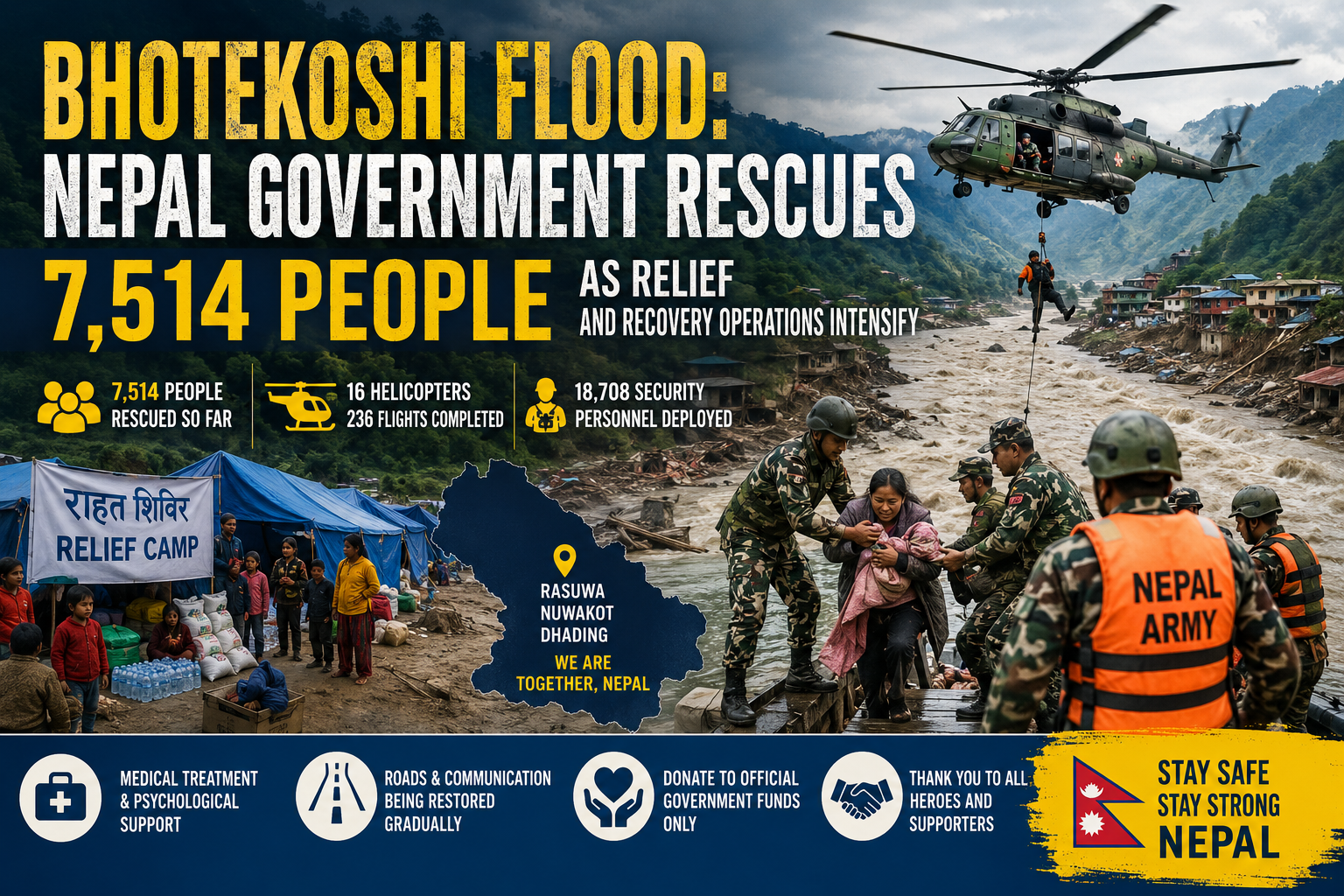
Bhotekoshi Flood: Nepal Government Rescues 7,514 People as Relief and Recovery Operations Intensify
Bhotekoshi Flood in Nepal: 7,514 People Rescued, Relief Operations Continue
The Nepal government has intensified rescue, medical treatment, relief distribution and infrastructure restoration following the devastating flood in the Bhotekoshi River that affected Rasuwa, Nuwakot, Dhading and other areas along the river corridor.
According to the government update, 7,514 people had been rescued and moved to safer locations by 5:30 PM, despite difficult weather conditions and challenging terrain.
The government said protecting the lives of affected citizens remains its top priority and that rescue and relief operations will continue until the situation is brought under control.
7,514 People Rescued Through Air and Ground Operations
Rescue teams have been using both helicopters and ground transportation to evacuate people from flood-affected areas.
A total of 16 helicopters, operated by the Nepal Army and private-sector operators, have been involved in rescue operations. These helicopters have completed 236 flights so far.
Among those rescued, 279 people stranded in different hydropower project areas have already been evacuated. Rescue efforts are continuing in locations where people remain trapped.
Nepal Army personnel are coordinating with Indian and Chinese experts during rescue operations.
Around 18,708 security personnel from the Nepal Army, Nepal Police and Armed Police Force have been deployed across affected areas.
Additional helicopters have also been kept on standby, although unfavorable weather and difficult geography have limited the number of flights that can operate simultaneously.
The government has also decided to increase daily food allowances and incentive payments for security personnel involved in high-risk rescue operations.
Medical Treatment and Psychological Support for Flood Victims
The government has arranged medical treatment for people injured in the Bhotekoshi flood and related disasters.
Seriously injured victims have been transported to hospitals in Kathmandu, while mobile hospitals have been established at the Nepal Army facilities in Dhunche, Rasuwa, and Battar, Nuwakot.
Medical teams involving specialists from Kathmandu are providing treatment in several locations.
Healthcare services are also being provided from five locations, including:
- Dhunche
- Syafrubesi
- Rasuwa Hospital
- Two locations in the affected heli areas
Psychological counseling is also being provided to injured people and their family members.
To improve blood availability, the government has introduced a Blood Information Portal, allowing information about blood availability at different hospitals to be made publicly accessible.
Temporary Shelters Established for Displaced Families
Thousands of people have been displaced by the flood.
The government, in coordination with district administrations and local governments, has established:
- 3 relief camps in Rasuwa
- 15 relief camps in Nuwakot
Around 3,500 displaced people have been provided temporary accommodation in schools and public or community buildings.
Relief supplies are being transported continuously by the federal government, while organizations including the Nepal Red Cross, Nepal Scouts, Lions Clubs and other volunteer groups have also been mobilized.
The National Disaster Risk Reduction and Management Authority has already released Rs. 6.75 crore for essential services in 15 local governments across five affected districts.
Government Appeals for Transparent Flood Relief Donations
The government is collecting financial assistance for flood victims through the Prime Minister’s Disaster Relief Fund and Prime Minister’s Fund.
According to the statement, contributions deposited into nine commercial bank accounts had reached Rs. 5.04 billion by midday.
An additional US$1.808 million had reportedly been deposited through Himalayan Bank and Laxmi Bank.
The government has urged the public and donors to contribute only through the officially published QR codes and bank accounts to prevent fraud and ensure transparent use of donations.
Relief materials are also being collected at several locations in Kathmandu, including:
- Tribhuvan International Airport warehouse
- Kathmandu District Administration Office
- Nepal Police Disaster Training Centre at Samakhusi
- Department of Urban Development and Building Construction premises at Babarmahal
Food and non-food relief supplies are being transported by air and road to affected areas, including Dhunche and Uttargaya.
International Support Arrives for Nepal Flood Response
International organizations and foreign governments have also pledged assistance for flood response, recovery and reconstruction.
The government says commitments include:
- US$5 million grant assistance from the Asian Development Bank
- US$167 million concessional loan from the World Bank
- US$500,000 from the United States
- US$1 million cash assistance from Australia
- US$150,000 in technical assistance from the Asian Development Bank
India has provided 57.5 tonnes of humanitarian assistance and essential medicines in three phases.
Additional humanitarian assistance is expected from China and the United States.
Nepal has also requested 30 Bailey bridges from China to support infrastructure restoration.
India and China have each provided 2,000 airtight bags for the management of recovered bodies.
Switzerland has also provided 1 million Swiss francs, to be spent through the United Nations.
Communication Networks Being Restored
The flood severely affected telecommunications infrastructure in the region.
Before the disaster, Nepal Telecom had 120 BTS towers and Ncell had 78 BTS towers operating in the affected areas.
The disaster disrupted:
- 38 Nepal Telecom towers
- 27 Ncell towers
Some towers suffered physical damage, while others stopped operating because of power shortages.
The government transported fuel, solar panels and generators by helicopter and road to restore telecommunications services.
So far, 90 Nepal Telecom towers and 71 Ncell towers have resumed operation, with repair work continuing on the remaining sites.
Restoring communication networks is considered critical for rescue coordination and communication between affected communities and emergency authorities.
Alternative Roads Reconnect Rasuwa and Dhading
Flood damage to major roads had made access to affected areas difficult.
Authorities have repaired an alternative road connecting Kathmandu to Rasuwa through the route:
Kathmandu–Tokha–Chhahare–Gadkhar Bridge–Aapre–Narja–Lachyang–Sarmathali–Patikharka–Bogatitaar–Kalikasthan–Dhunche
The road has been reopened for small four-wheel-drive vehicles, reconnecting Rasuwa with the national road network.
The Galchhi–Malekhu section of the Prithvi Highway, covering approximately 13 kilometers, has also been cleared of accumulated mud and restored to full operation.
An alternative route to Dhadingbesi has also been opened through:
Parewat ar–Nepaltar–Gajuritar–Pipaltar–Adamtar–Belintar–Keurinitar–Mastar
This has restored road connectivity to Dhadingbesi.
675 Bodies Recovered From Flood-Affected Districts
The government reported that 675 bodies had been recovered from different locations across Rasuwa, Dhading, Nuwakot, Chitwan, Tanahun, Gorkha, Nawalparasi East and Nawalparasi West.
Authorities are using airtight bags for body management.
Bodies that cannot immediately be identified will be handled according to the Unidentified and Unclaimed Body Management Directive, 2083, while DNA samples and other identification-related evidence will be preserved where necessary.
Bodies identified by family members will be handed over to relatives.
The government has urged the public not to believe misinformation or unverified claims regarding the management of recovered bodies.
Government Urges Responsible Information Sharing
The government has thanked security personnel, government employees, volunteers, civil society organizations and citizens for their efforts during the disaster.
It has also appealed to news organizations and social media users to share accurate and verified information.
During a major natural disaster, misinformation can create additional fear and confusion among affected families. The government has therefore emphasized that information should focus on saving lives, supporting victims and strengthening public confidence.
Nepal Flood Situation: Government Says Rescue Operations Will Continue
The government has reiterated that rescue, relief, treatment and rehabilitation operations will continue until necessary results are achieved.
The Bhotekoshi flood has created a major humanitarian and infrastructure challenge across several districts, with rescue teams working simultaneously on evacuation, medical care, temporary shelter, food distribution, telecommunications restoration and road connectivity.
Authorities say coordination among the federal, provincial and local governments will remain essential as Nepal moves from immediate rescue operations toward relief, rehabilitation and long-term reconstruction.
For affected families, the immediate priorities remain clear: rescuing people who are still stranded, providing medical assistance, delivering essential supplies and restoring access to communication and transportation.
Frequently Asked Questions About the Bhotekoshi Flood
What happened in the Bhotekoshi River?
A devastating flood in the Bhotekoshi River affected Rasuwa, Nuwakot, Dhading and other downstream areas, causing significant loss of life, displacement and damage to infrastructure.
How many people have been rescued?
According to the government update, 7,514 people had been rescued through air and ground operations by 5:30 PM.
How many security personnel are involved in the rescue?
Approximately 18,708 personnel from the Nepal Army, Nepal Police and Armed Police Force have been deployed in affected areas.
How many helicopters are being used?
A total of 16 helicopters, including Nepal Army and private-sector helicopters, have been involved in the rescue operation and have completed 236 flights.
How many people have been displaced?
Approximately 3,500 displaced people have been provided temporary accommodation in schools and public or community buildings.
Which districts have been affected?
Rasuwa, Nuwakot and Dhading are among the major affected districts, while recovered bodies and flood impacts have also been reported in Chitwan, Tanahun, Gorkha and both Nawalparasi districts.
Is road access to Rasuwa restored?
An alternative road route has been repaired to reconnect Rasuwa with the national road network. It is currently suitable for small four-wheel-drive vehicles.
What is being done for injured flood victims?
Seriously injured victims are being transported to Kathmandu hospitals, while mobile hospitals and medical teams are providing treatment in Rasuwa and Nuwakot.
How can people help flood victims?
The government has urged donors to use only officially published bank accounts and QR codes associated with the designated government relief funds to avoid fraud and ensure transparency.


Leave a Comments
Comments
Related post

Popular




No comments yet.