

Charlie Munger Mental Models for Better Investing
Charlie Munger Mental Models: How Psychology Can Improve Your Investing Decisions
Some of the worst investing decisions happen when investors already know what they should do—but allow emotions, hype, or the crowd to influence their decisions.
You may know that chasing a rising stock is risky. You may understand the importance of researching a company before investing. You may even know that following the crowd is not a reliable investment strategy.
Yet, when emotions take over, knowing the right thing does not always mean doing the right thing.
This is one of the most important lessons investors can learn from Charlie Munger's mental models: successful investing is not only about understanding businesses and financial statements. It is also about understanding human psychology, behavioral biases, risk, and decision-making.
For investors learning about the Nepal stock market, these principles can be particularly useful when analyzing NEPSE stocks and making investment decisions.
Why Investors Make Poor Decisions Even When They Know Better
Investing mistakes are not always caused by a lack of financial knowledge.
Sometimes, the problem is behavioral.
An investor may understand fundamental analysis but still buy a stock because it is trending on social media. Another investor may know that markets experience corrections but panic when their portfolio falls sharply.
Common psychological factors that influence investment decisions include:
- Herd mentality – following what other investors are buying.
- Overconfidence – believing your analysis is more accurate than it really is.
- Confirmation bias – looking for information that supports an existing opinion.
- Fear – selling investments because of short-term market declines.
- Envy – buying after seeing others make quick profits.
- Social proof – assuming an investment is good simply because many people are buying it.
- Incentives – overlooking how financial incentives can influence decisions.
Understanding these biases can help investors develop a more disciplined approach to investing.
Charlie Munger and the Psychology of Investing
Charlie Munger was widely known for emphasizing the importance of understanding psychology and human behavior.
One of the central ideas behind his approach was that investors should develop a collection of mental models—simple frameworks that can help them analyze problems from different perspectives.
Instead of asking only:
"Is this a good company?"
Investors can also ask:
- What assumptions am I making?
- What evidence supports my investment thesis?
- What evidence contradicts it?
- Am I following fundamentals or market excitement?
- What incentives influence the people involved?
- What could I be overlooking?
- What happens if my assumptions are wrong?
These questions can make investment analysis more systematic.
The Danger of Following Market Hype
One of the most common investment mistakes is buying an asset simply because everyone else appears to be making money from it.
A rising stock can create FOMO (fear of missing out).
Investors may see a stock moving rapidly upward and assume they must buy immediately. However, price momentum alone does not explain whether a company is fundamentally attractive or whether its valuation is reasonable.
For NEPSE investors, separating market sentiment from company fundamentals can be an important part of disciplined investing.
Before buying a stock, investors can examine factors such as:
- Earnings growth
- Revenue growth
- Profit margins
- Return on equity
- Debt levels
- Cash flow
- Valuation
- Dividend history
- Industry conditions
- Management quality
- Future growth prospects
Technical analysis can also be used to understand price trends, support and resistance, volume, momentum, and market structure.
Confirmation Bias: The Investment Mistake That Can Be Hard to Notice
Confirmation bias occurs when people favor information that supports what they already believe while giving less attention to information that challenges their view.
For example, an investor may decide that a particular NEPSE stock is going to rise.
After making that decision, they may:
- Search for bullish news.
- Read positive analyst opinions.
- Focus on favorable technical indicators.
- Ignore negative financial developments.
- Dismiss information that challenges their thesis.
The result can be an investment decision that feels well researched but is actually one-sided.
A better approach is to deliberately search for evidence that could prove your investment thesis wrong.
Overconfidence Can Increase Investment Risk
Confidence can be useful, but overconfidence can become dangerous.
An investor who has experienced several successful trades may begin believing that they can consistently predict short-term market movements.
This can lead to:
- Larger position sizes
- Excessive trading
- Ignoring stop-loss levels
- Concentrated portfolios
- Taking unnecessary risks
- Trading without a clear investment plan
A disciplined investor should consider both potential returns and potential losses before entering a position.
What Happens If You Are Wrong?
One of the most useful questions investors can ask is:
"What happens if my analysis is wrong?"
This question encourages investors to think about risk before thinking about potential profit.
For example:
If you believe a stock will rise because earnings are improving, ask what would happen if earnings decline.
If you believe a breakout will continue, ask what happens if the breakout fails.
If you believe the broader NEPSE trend is changing, consider what evidence would invalidate that view.
This approach can help investors avoid becoming emotionally attached to an investment thesis.
Mental Models for Better Investment Decisions
Charlie Munger's mental-model approach encourages investors to look at problems from multiple perspectives.
Some useful mental models for investors include:
1. Incentives
Ask who benefits from a particular decision, recommendation, transaction, or piece of information.
2. Confirmation Bias
Actively search for evidence that challenges your existing investment thesis.
3. Social Proof
Do not assume an investment is attractive simply because many people are buying it.
4. Opportunity Cost
Money invested in one stock cannot simultaneously be invested elsewhere. Compare potential opportunities rather than evaluating an investment in isolation.
5. Inversion
Instead of asking only, "How can this investment succeed?", ask:
"What could cause this investment to fail?"
6. Margin of Safety
Avoid relying on overly optimistic assumptions. Build room for uncertainty into your investment decisions.
7. Second-Order Thinking
Consider what could happen after the first obvious outcome.
For example, a positive announcement may initially push a stock higher, but investors can also consider how the market may react after expectations become priced in.
Knowledge Is Not Enough for Successful Investing
Learning fundamental analysis, technical analysis, financial statements, valuation, and market indicators can improve an investor's knowledge.
But knowledge alone does not guarantee disciplined behavior.
An investor can know that markets are volatile and still panic during a correction.
An investor can understand valuation and still chase an expensive stock because of FOMO.
An investor can understand diversification and still concentrate too much money in one idea.
The challenge is turning knowledge into consistent behavior.
That is where investment discipline and decision-making frameworks become important.
Apply These Ideas to the Nepal Stock Market
For people learning to invest in Nepal, developing both market knowledge and decision-making discipline can be valuable.
A structured learning process can include:
- Understanding the NEPSE market
- Fundamental analysis
- Technical analysis
- Financial statement analysis
- Company valuation
- Portfolio management
- Risk management
- Investor psychology
- Behavioral finance
- Trading discipline
If you are looking for share market training in Nepal, Sarbaguna provides educational resources and market-focused learning opportunities designed to help investors understand the Nepal stock market.
Explore Sarbaguna.com for information about share market training Nepal, NEPSE analysis courses, stock market education, technical analysis training, and investment learning resources.
Final Thoughts
Becoming a better investor is not simply about collecting more information.
It is about developing the ability to make decisions when fear, greed, excitement, FOMO, and uncertainty are influencing your thinking.
Charlie Munger's mental-model approach provides a useful framework for questioning assumptions and identifying behavioral mistakes.
Before making your next investment decision, ask yourself:
Am I following the evidence—or simply looking for reasons to believe what I already want to believe?
That simple question can be a powerful starting point for better investment discipline.
Learn Share Market Analysis in Nepal
If you want to develop your understanding of NEPSE analysis, fundamental analysis, technical analysis, stock market investing, risk management, and investor psychology, consider structured share market training in Nepal.
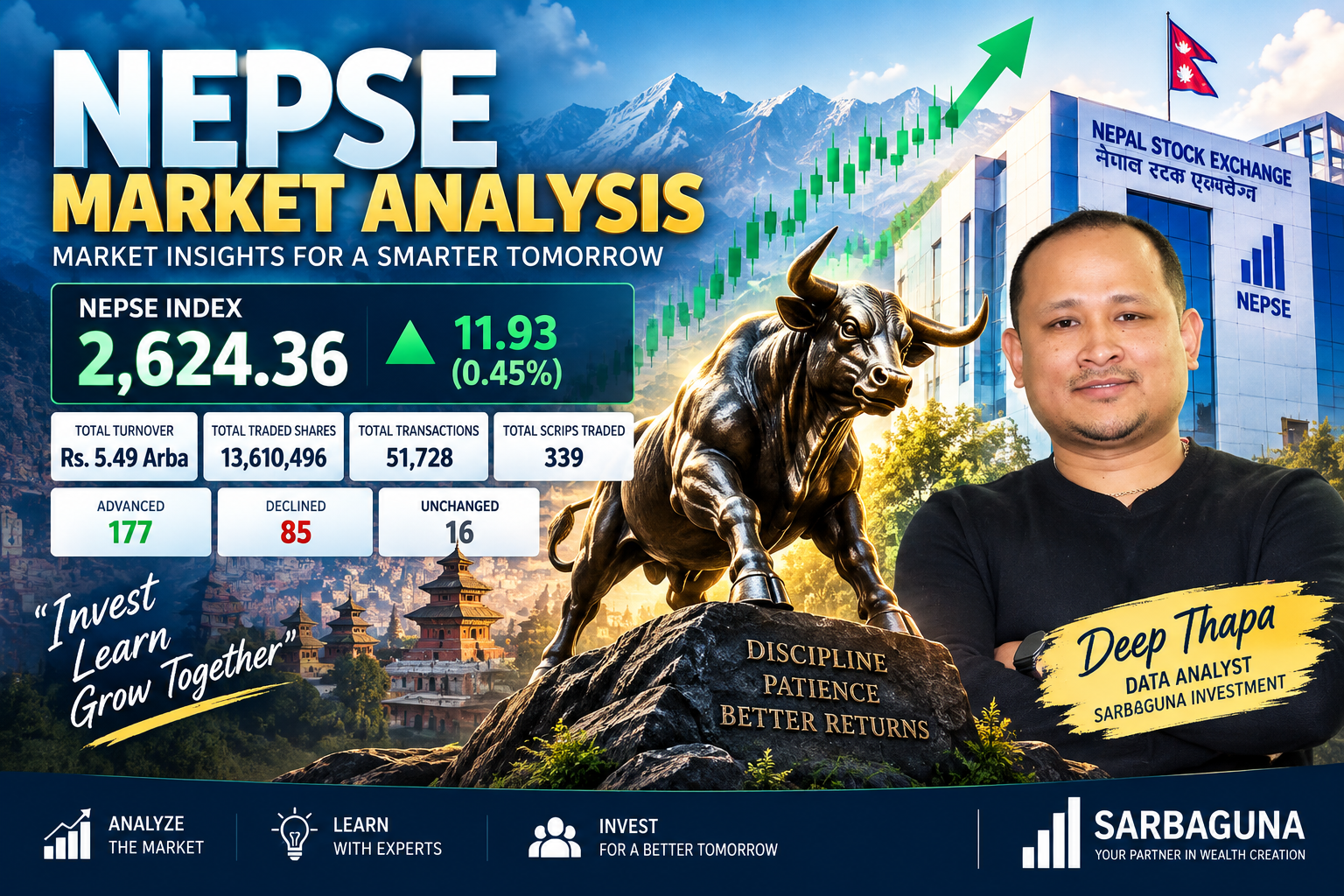
For training information and guidance, contact Deep Thapa:
Call / WhatsApp: 9849290806
Visit Sarbaguna.com to explore market education and stock market learning resources.
Frequently Asked Questions
What are Charlie Munger's mental models?
Charlie Munger's mental models are thinking frameworks used to analyze problems and make better decisions. They include concepts related to incentives, psychology, probability, opportunity cost, inversion, and behavioral biases.
How can mental models help investors?
Mental models can help investors identify behavioral biases, challenge assumptions, evaluate risk, and consider different perspectives before making an investment decision.
What is confirmation bias in investing?
Confirmation bias occurs when investors favor information that supports their existing beliefs while ignoring or discounting information that challenges those beliefs.
What is herd mentality in the stock market?
Herd mentality occurs when investors follow the actions of other market participants rather than independently evaluating an investment based on its fundamentals, valuation, risk, and objectives.
How can investors avoid emotional investing?
Investors can reduce emotional decision-making by creating an investment plan, defining risk limits, researching investments before buying, diversifying appropriately, and using objective criteria to review their investment thesis.
Can Charlie Munger's ideas be applied to the Nepal stock market?
Yes. The general principles behind mental models—such as understanding incentives, avoiding confirmation bias, questioning assumptions, and considering downside risk—can be applied when analyzing companies listed on NEPSE.
Where can I learn share market analysis in Nepal?
Investors interested in share market training in Nepal, NEPSE analysis, technical analysis, fundamental analysis, and stock market education can explore learning resources at Sarbaguna.com or contact Deep Thapa at 9849290806.


Leave a Comments
Comments

Popular






Recent Post
No comments yet.