

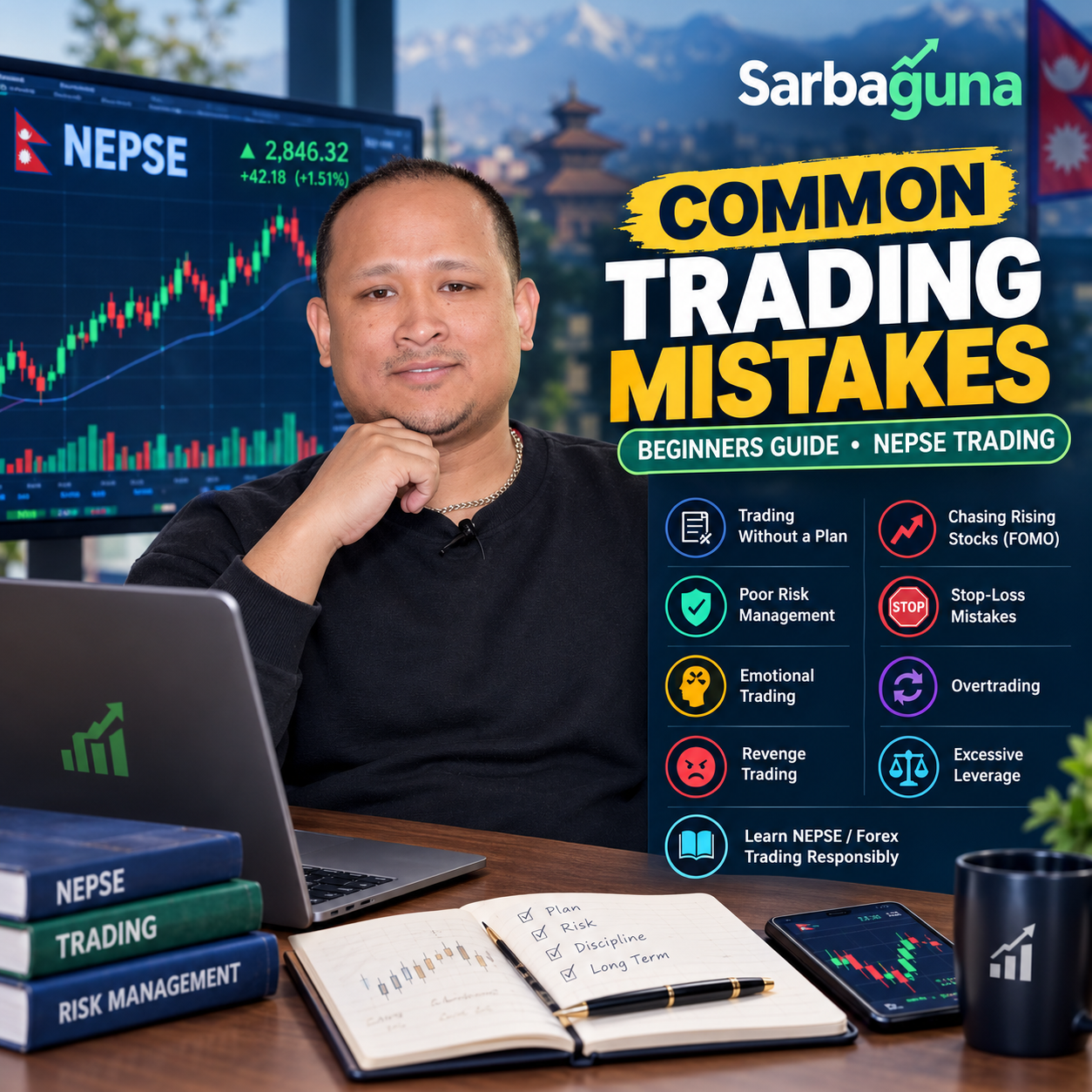
Common Trading Mistakes Beginners Make | Trading Guide Nepal
Common Trading Mistakes Beginners Make
Trading can provide opportunities in stocks, currencies and other financial markets, but entering a trade without proper preparation can quickly turn a potential opportunity into a significant loss.
Many beginner traders make similar mistakes: entering trades without a plan, chasing rapidly rising prices, risking too much capital, ignoring stop-loss levels, following market rumors and allowing emotions to control decisions.
For investors and traders in Nepal, understanding these mistakes is especially important when participating in the NEPSE stock market, learning technical analysis or exploring the principles of forex trading.
The objective of successful trading should not be to win every trade. Instead, traders should focus on capital protection, disciplined execution, risk management and continuous learning.
If you are looking for structured Share Market Training in Nepal, learning how to avoid common trading mistakes should be one of the first steps.
1. Trading Without a Clear Trading Plan
One of the biggest mistakes beginners make is entering a trade without knowing exactly why they are entering.
A trading plan should define:
- Entry price or entry conditions
- Target price
- Stop-loss level
- Maximum acceptable loss
- Position size
- Trading timeframe
- Reason for taking the trade
- Conditions for exiting the trade
Without a plan, traders often change their decisions after entering a position. A small loss can turn into a large loss because the trader keeps hoping that the market will reverse.
A disciplined trader prepares the trade before placing the order.
2. Chasing Rising Stocks and Market Performance
Seeing a stock rise sharply can create the fear of missing out, commonly known as FOMO.
Beginners may buy a stock simply because:
- It has increased significantly
- Everyone is discussing it
- Social media is promoting it
- Trading volume has suddenly increased
- Other traders claim they made money from it
However, strong past performance does not guarantee that the same move will continue.
In NEPSE, traders should analyze the trend, volume, support and resistance, valuation, company fundamentals and broader market conditions before making an investment decision.
Do not confuse a stock that has already risen significantly with a stock that still has a favorable risk-to-reward setup.
3. Ignoring Risk Management
Trading is not only about identifying profitable opportunities. It is also about controlling losses.
A trader should understand how much capital can reasonably be placed at risk on an individual trade.
Important risk-management concepts include:
- Position sizing
- Stop-loss placement
- Risk-to-reward ratio
- Portfolio diversification
- Maximum daily or weekly loss
- Capital preservation
Even a good trading strategy can produce losing trades. Proper risk management helps prevent a few unsuccessful trades from seriously damaging trading capital.
4. Trading Without Considering the Time Horizon
Different strategies require different time horizons.
A long-term investor may hold a fundamentally strong company for years, while a swing trader may hold a position for several days or weeks. An intraday trader may open and close a position within the same trading session.
Problems arise when traders mix these approaches emotionally.
For example, a trader may enter a short-term trade but, after the price falls, decide to hold the stock for years simply because they do not want to accept the loss.
Before entering a position, ask:
"Am I investing or trading, and how long do I intend to hold this position?"
5. Not Using a Proper Stop-Loss Strategy
A stop-loss is an important tool for controlling downside risk.
Beginners sometimes avoid stop-losses because they believe the price will eventually recover.
This can be dangerous.
A properly planned stop-loss can help traders define their maximum acceptable loss before entering a position. The exact level should be based on the trading setup, volatility, support/resistance and overall risk management rather than an arbitrary percentage.
However, traders should also understand that stop orders are not guaranteed to execute at exactly the chosen price in every market condition, particularly during sudden price gaps or extreme volatility.
6. Allowing Small Losses to Become Large Losses
One of the most damaging habits in trading is refusing to accept a losing position.
A trader may think:
"The price will come back."
Sometimes it does. Sometimes it does not.
Holding a losing trade without a predefined exit strategy can tie up capital and increase the potential loss.
Professional trading is not about avoiding every loss. It is about keeping losses controlled when a trade thesis is invalidated.
7. Averaging Down Without a Proper Strategy
Buying more of a falling stock can reduce the average purchase price, but that does not automatically make the investment safer.
Before averaging down, traders should investigate:
- Why did the price fall?
- Has the company's fundamental outlook changed?
- Is the broader market weakening?
- Has the technical structure broken?
- Is support still valid?
- Is there sufficient liquidity?
- Does the original investment thesis remain intact?
Blindly adding to a losing position can increase exposure to a trade that is already moving against you.
8. Buying a Stock Simply Because It Looks Cheap
A stock trading significantly below its previous high is not automatically undervalued.
A falling price may result from:
- Weak earnings
- Poor business performance
- High debt
- Declining profitability
- Corporate governance concerns
- Sector weakness
- Negative market expectations
- Deteriorating fundamentals
Instead of asking only "How much has the stock fallen?", investors should ask:
"Why has it fallen, and what could make the company recover?"
This is where fundamental analysis becomes important.
For learners who want to develop practical NEPSE analysis skills, Sarbaguna's Share Market Training covers fundamental and technical concepts relevant to Nepal's stock market.
9. Believing Every Buy or Sell Signal
Technical indicators can be useful, but no indicator provides a perfect signal.
Beginners sometimes rely completely on:
- RSI
- MACD
- Moving averages
- Candlestick patterns
- Support and resistance
- Trading volume
- Chart patterns
A technical signal should be evaluated in context.
For example, an oversold RSI does not automatically mean a stock must rise. Similarly, a bullish crossover does not guarantee a profitable trade.
A stronger approach combines market structure, price action, volume, technical indicators and risk management.
10. Using Too Much Margin
Margin can increase the size of a position relative to available capital, but it can also increase losses.
A beginner who does not fully understand margin requirements, liquidation risks, financing costs and position sizing can expose their account to unnecessary risk.
Before using borrowed capital, traders should understand:
- Maximum potential loss
- Margin requirements
- Interest or financing costs
- Margin-call conditions
- Liquidation procedures
- Volatility of the underlying asset
If you do not fully understand the risks of leverage or margin, avoiding excessive exposure is generally safer than learning through a large loss.
11. Using Excessive Leverage in Forex Trading
Forex trading is particularly sensitive to leverage.
Leverage allows traders to control a larger position with a smaller amount of capital. While this can amplify gains, it can also amplify losses.
For example, a highly leveraged position can experience a substantial percentage loss from a relatively small adverse movement in the currency pair.
Beginners should therefore prioritize:
- Risk management
- Position sizing
- Stop-loss planning
- Trading psychology
- Understanding currency pairs
- Market analysis
- Demo practice
- Understanding leverage
If you are interested in learning these concepts systematically, explore the Forex Trading Course in Nepal offered by Sarbaguna.
Important: Forex trading involves substantial risk, and there is no guarantee of profit.
12. Following the Crowd
Market sentiment can influence prices, but blindly following other traders can lead to poor decisions.
Beginners may buy because:
- A stock is trending on social media
- Friends are buying
- A WhatsApp group is promoting it
- Someone claims to have inside information
- A stock has reached a new high
- Everyone expects a circuit movement
Instead of simply following the crowd, traders should perform their own analysis.
Ask:
What is the reason for this trade?
If the only answer is "everyone else is buying," the trade may not have a sufficiently strong foundation.
13. Putting Too Much Money Into One Stock
Concentrating too much capital in a single stock increases portfolio-specific risk.
Diversification does not eliminate risk, but it can reduce the impact of one company's negative performance on the overall portfolio.
Investors should consider diversification across appropriate:
- Companies
- Sectors
- Investment styles
- Time horizons
- Asset classes
However, diversification should also be purposeful. Owning many securities without understanding them does not automatically create a well-managed portfolio.
14. Trading Without Doing Research
Another major mistake is entering a trade based on a headline, rumor or social-media post without conducting independent research.
Before buying or selling, investors should consider:
Fundamental Analysis
- Earnings
- EPS
- Book value
- Revenue
- Profitability
- Debt
- Cash flow
- Valuation
Technical Analysis
- Trend
- Support
- Resistance
- Volume
- Moving averages
- Momentum
- Market structure
Market Context
- NEPSE trend
- Sector performance
- Liquidity
- Investor sentiment
- Macroeconomic conditions
A structured approach is generally better than relying on a single piece of information.
15. Letting Emotions Control Trading Decisions
Trading psychology can be as important as technical knowledge.
Two powerful emotions are fear and greed.
Fear can cause traders to:
- Exit too early
- Avoid valid setups
- Sell during panic
- Move stop-losses irrationally
Greed can cause traders to:
- Increase position size
- Ignore targets
- Chase prices
- Use excessive leverage
- Continue trading after reaching their daily limit
A trading plan helps reduce emotional decision-making.
16. Overtrading
More trades do not necessarily mean more profits.
Beginners sometimes feel that they must constantly participate in the market.
This can lead to:
- Excessive transaction costs
- Emotional exhaustion
- Poor-quality setups
- Revenge trading
- Impulsive decisions
- Reduced concentration
A better approach is to wait for setups that match a clearly defined strategy.
No trade is also a trading decision.
17. Revenge Trading After a Loss
Losing money can create a strong desire to immediately recover it.
A trader may increase position size or enter a low-quality setup after a loss.
This is known as revenge trading.
For example:
Loss → frustration → larger trade → another loss → even larger trade
This cycle can rapidly damage trading capital.
After a significant loss, stepping away from the market and reviewing the trade objectively can be more productive than immediately attempting to recover the money.
18. Switching Strategies Too Frequently
Beginners may move from one strategy to another after experiencing a few losing trades.
One week they may use:
- RSI
The next week:
- MACD
Then:
- Moving averages
Then:
- Price action
Then:
- Breakout trading
Changing strategies continuously makes it difficult to determine whether the strategy actually works.
A better approach is to learn one framework thoroughly, test it with historical or demo data, and understand its strengths and weaknesses.
19. Expecting Trading to Produce Quick Wealth
Trading is not a guaranteed shortcut to financial success.
Anyone promising guaranteed profits, guaranteed forex returns or risk-free stock-market income should be treated cautiously.
Developing trading skills requires:
- Education
- Practice
- Discipline
- Market observation
- Risk management
- Record keeping
- Continuous improvement
The goal should be to build a repeatable process rather than search for a "perfect" trade.
A Simple Trading Checklist for Beginners
Before entering any trade, ask these questions:
Trading Plan
- Why am I entering?
- What is my entry?
- Where is my stop-loss?
- What is my target?
- What is my risk-to-reward ratio?
Risk Management
- How much capital am I risking?
- Can I afford the potential loss?
- Is my position size appropriate?
Technical Analysis
- What is the current trend?
- Where are support and resistance?
- Is volume confirming the move?
- Is the setup technically valid?
Fundamental Analysis
- Are the company's fundamentals healthy?
- Is the valuation reasonable?
- Is there any major company-specific risk?
Psychology
- Am I trading because of FOMO?
- Am I trying to recover a previous loss?
- Am I following someone else's tip?
- Am I emotionally attached to this trade?
If the answers are unclear, consider waiting rather than forcing a trade.
How Beginners Can Become Better Traders
Becoming a better trader is a process.
A practical learning path can include:
Step 1: Learn market basics
Step 2: Understand fundamental analysis
Step 3: Learn technical analysis
Step 4: Study price action and market structure
Step 5: Learn risk management
Step 6: Develop a trading plan
Step 7: Practice with historical or demo data
Step 8: Maintain a trading journal
Step 9: Review winning and losing trades
Step 10: Improve the strategy gradually
For Nepalese investors, Sarbaguna Trading School provides practical education covering NEPSE, technical analysis, fundamental analysis, trading psychology and risk management.
Learn Stock Market and Forex Trading in Nepal
If you want to develop your market knowledge instead of depending entirely on stock tips, structured education can help you understand how financial markets work.
Sarbaguna provides education covering:
- NEPSE and Nepal share market
- Fundamental analysis
- Technical analysis
- Candlestick patterns
- Price action
- Support and resistance
- Trading strategies
- Risk management
- Trading psychology
- Portfolio management
- Forex trading concepts
For learners interested specifically in currency markets, the Forex Trading Course in Nepal focuses on market analysis, trading strategies, risk management and practical understanding of forex markets.
Contact Sarbaguna
Deep Thapa
Call / WhatsApp: 9849290806
Learn before you trade. Build a plan before you risk capital.
Frequently Asked Questions About Beginner Trading Mistakes
What is the biggest mistake beginner traders make?
One of the biggest mistakes is trading without a clear plan. Beginners should know their entry, exit, stop-loss, position size and maximum acceptable risk before entering a trade.
How can beginners avoid losing money in trading?
Beginners can reduce unnecessary losses by learning market fundamentals, using proper risk management, controlling position size, avoiding excessive leverage, using appropriate stop-loss strategies and maintaining trading discipline.
Is technical analysis enough for successful trading?
Technical analysis can help traders study price trends, momentum, volume and market structure, but it does not guarantee profitable trades. Combining technical analysis with risk management and appropriate fundamental or market-context analysis can provide a more complete decision-making framework.
Should beginners use leverage in forex trading?
Beginners should be extremely cautious with leverage. Leverage can magnify both gains and losses, and excessive leverage can result in rapid capital losses.
Why do traders keep holding losing positions?
Traders may hold losing positions because of fear, hope, emotional attachment, overconfidence or unwillingness to accept a mistake. A predefined exit strategy can help reduce this behavior.
Is averaging down always a good strategy?
No. Averaging down can increase exposure to a declining asset. Before adding to a losing position, traders should reassess the original investment thesis, company fundamentals, technical structure and overall risk.
What is revenge trading?
Revenge trading occurs when a trader makes impulsive trades after a loss with the goal of quickly recovering the lost money. It often results in larger losses because decisions become emotionally driven.
How important is trading psychology?
Trading psychology is extremely important because fear, greed, FOMO, impatience and overconfidence can cause traders to abandon otherwise reasonable strategies.
How can I learn stock market trading in Nepal?
You can learn through structured Stock Market Classes in Nepal covering NEPSE basics, technical analysis, fundamental analysis, risk management, trading psychology and practical market analysis.
Where can I learn Forex trading in Nepal?
Sarbaguna offers a Forex Trading Course in Nepal covering forex concepts, market analysis, trading strategies and risk management.
Can trading guarantee a fixed profit?
No. Trading and investing involve risk, and no legitimate strategy can guarantee a fixed return. Traders should be cautious of claims of guaranteed profits or risk-free trading.
Final Thoughts
The difference between a disciplined trader and an impulsive trader is often not the ability to predict every market movement.
It is the ability to manage risk, follow a plan, control emotions and learn from mistakes.
Avoiding common trading mistakes can help beginners build a stronger foundation for participating in the NEPSE stock market and understanding global financial markets.
Whether your goal is stock market investing, technical analysis, NEPSE trading or Forex trading, education and disciplined risk management should come before chasing profits.
Learn. Analyze. Plan. Manage Risk. Then Trade.
Deep Thapa – Sarbaguna
Call / WhatsApp: 9849290806
Disclaimer: This article is for educational and informational purposes only and does not constitute financial, investment, legal or regulatory advice. Trading and investing involve risk, and past performance does not guarantee future results. Forex and leveraged trading can result in substantial losses. Always conduct your own research and consider applicable laws, regulations and professional advice before making financial decisions.


Leave a Comments
Comments

Popular






Recent Post

No comments yet.