

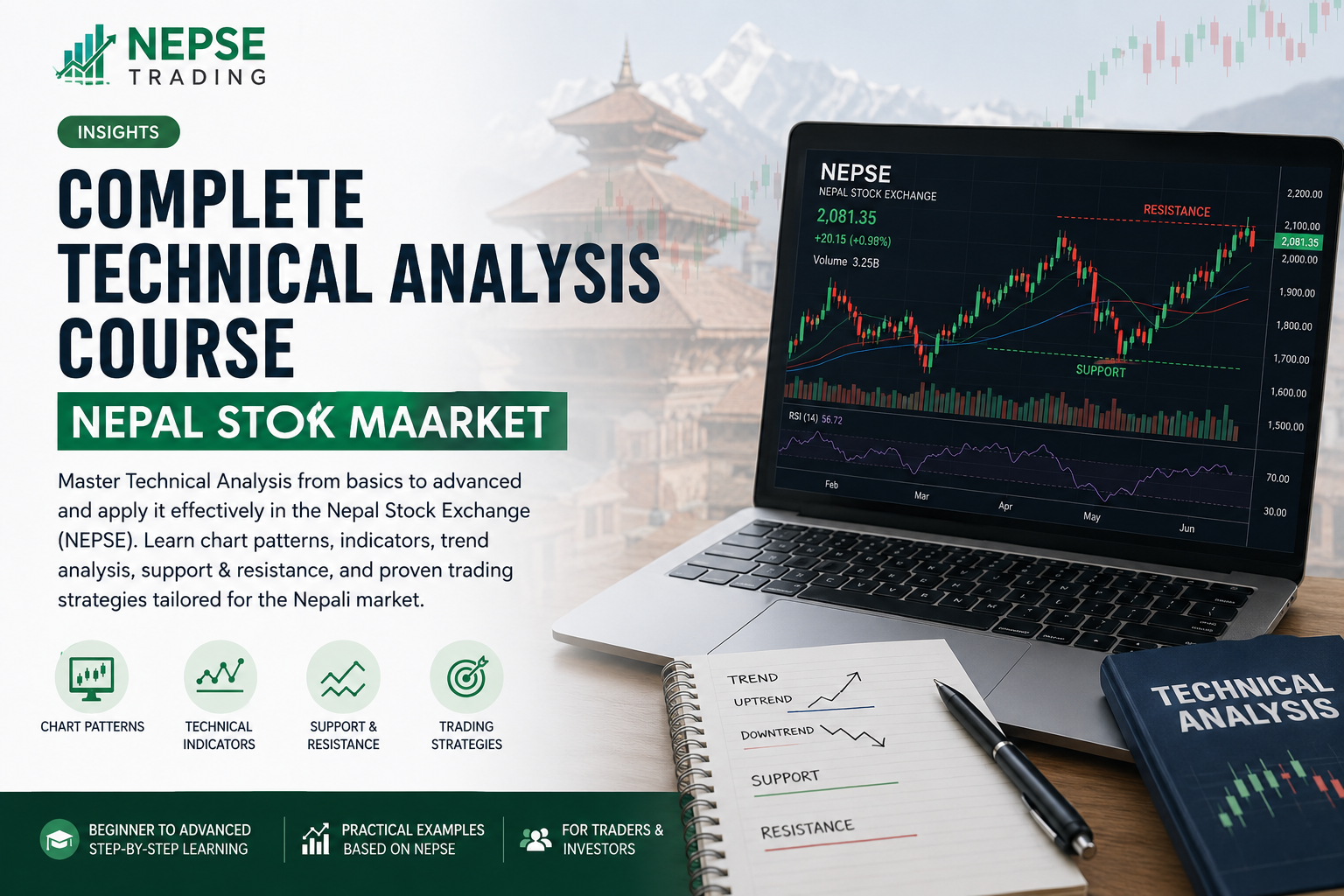
Complete Technical Analysis Course for Nepal Stock Market
By Sarbaguna Investment
Technical analysis is one of the most effective ways to understand market behavior, identify trading opportunities, and manage risk in the Nepal stock market. Whether you are a beginner investor or an active trader, learning technical analysis can help you make more disciplined and informed decisions.
This complete course is designed specifically for the NEPSE market and focuses on practical concepts that traders can apply using real market data and chart behavior. The course covers everything from candlestick basics to advanced trading strategies and risk management techniques. Inspired by common NEPSE trading methodologies and market practices.
What You Will Learn
Module 1: Candlestick Patterns & Price Action
Learn how to read price charts and identify major candlestick formations used by professional traders.
Topics include:
- Bullish & bearish engulfing
- Doji patterns
- Hammer & shooting star
- Morning & evening star
- Supportive price action structures
- Market psychology behind candles
You will also understand how these patterns appear in real NEPSE stocks and how traders use them to predict possible reversals or continuations.
Module 2: Trend Analysis
A trader must first identify the market trend before entering any trade.
In this module, you will learn:
- Moving averages
- Golden cross & death cross
- Trendline drawing
- ADX indicator
- Identifying bullish and bearish markets
- Swing highs & swing lows
Understanding trends helps traders avoid emotional decisions and trade with the market direction.
Module 3: Momentum Indicators
Momentum indicators help measure the strength of a move and possible reversals.
Topics covered:
- RSI (Relative Strength Index)
- MACD crossover strategies
- Stochastic oscillator
- Divergence trading
- Overbought & oversold conditions
These tools are commonly used by NEPSE traders to time entries and exits more effectively.
Module 4: Volume Analysis
Volume confirms whether market moves are strong or weak.
You will learn:
- Volume breakout confirmation
- Accumulation & distribution
- OBV (On Balance Volume)
- Smart money concepts
- Institutional buying signals
Volume analysis is especially important in the Nepal stock market where liquidity plays a major role in price movement.
Module 5: Support & Resistance
Support and resistance levels are key areas where buyers and sellers react strongly.
Topics include:
- Horizontal support & resistance
- Pivot points
- Fibonacci retracement
- Dynamic support using moving averages
- Breakout & retest strategies
These concepts help traders determine entry points, stop losses, and profit targets.
Module 6: Volatility & Bollinger Bands
Volatility creates trading opportunities.
In this module:
- Bollinger Bands
- Band squeeze strategy
- ATR (Average True Range)
- Volatility breakout setup
- Risk-adjusted trading
You will learn how to identify explosive price moves before they happen.
Module 7: Sector Analysis in NEPSE
Different sectors perform differently during market cycles.
This section teaches:
- Banking sector analysis
- Hydropower trends
- Finance & microfinance movement
- Sector rotation strategy
- Relative strength comparison
Understanding sector movement can help investors identify where money is flowing in the market.
Module 8: Strategy Development & Risk Management
This is where all concepts come together into a complete trading system.
Topics include:
- Combining indicators
- Trade setup building
- Backtesting strategies
- Position sizing
- Stop-loss placement
- Risk-reward ratio
- Trading psychology
Risk management is one of the most important skills for long-term success in trading.
Why Learn Technical Analysis?
Technical analysis helps traders:
- Identify high-probability opportunities
- Improve timing of entries and exits
- Reduce emotional trading
- Manage risk professionally
- Understand market sentiment
- Build a consistent trading strategy
Many experienced NEPSE traders believe technical analysis works best when combined with discipline, research, and proper risk management. Community discussions among Nepalese traders often highlight the importance of experience, process, and practice rather than relying only on indicators.
Is Technical Analysis Useful in NEPSE?
Technical analysis is widely used in Nepal’s stock market for swing trading and short- to medium-term market analysis. While no strategy guarantees profit, traders use charts, volume, and indicators to understand market behavior and improve decision-making.
Many traders combine:
- Technical analysis for timing
- Fundamental analysis for stock selection
- Risk management for capital protection
Community opinions remain mixed, but experienced participants generally agree that technical analysis becomes more effective with practice and discipline.
Who Is This Course For?
This course is suitable for:
- Beginner investors
- Swing traders
- Long-term investors wanting better entry timing
- Students interested in finance
- NEPSE market participants
- Anyone wanting structured stock market education
Final Thoughts
Technical analysis is not about predicting the future perfectly. It is about understanding probability, managing risk, and making better trading decisions consistently.
The Nepal stock market continues to grow, and traders who build strong analytical skills can gain a significant advantage over emotional market participants.
At Sarbaguna Investment, we believe successful investing comes from education, discipline, and continuous learning. Start with the basics, practice regularly, and gradually develop your own trading approach based on data and experience.
For more stock market education, investment insights, and NEPSE trading resources, visit:
Sarbaguna Investment Official Website
Join Sarbaguna Investment
 Sarbaguna Investment – Empowering Smart Trading Decisions in NEPSE
 SMS Pack / WhatsApp Group: +977-9849290806
 Get daily market updates, technical analysis, trading signals, and stock market training.
 Learn. Invest. Grow.
Tags


Leave a Comments
Comments


Popular





Recent Post
No comments yet.