

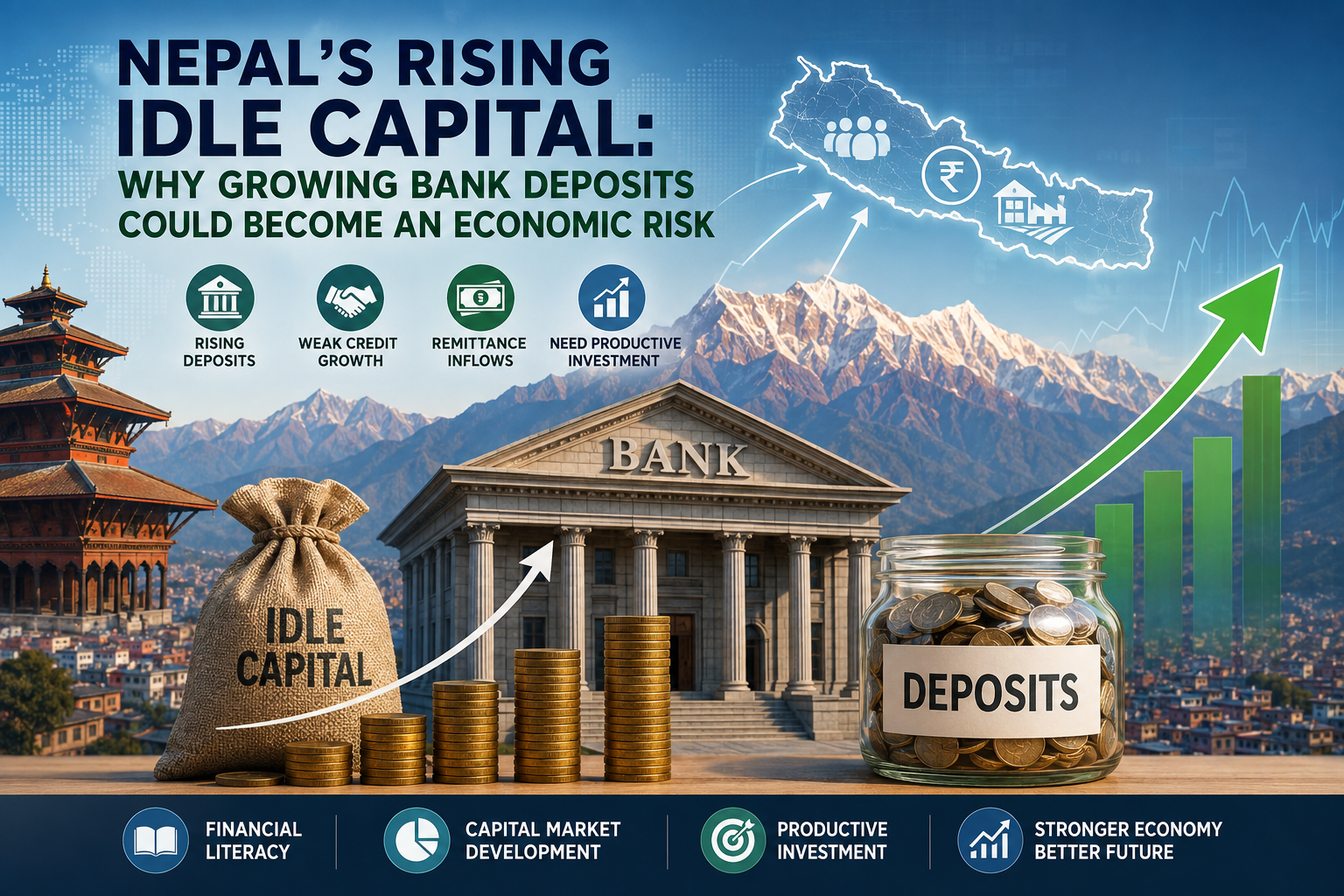
Nepal’s Rising Bank Deposits and Idle Capital: Economic Risks Explained
Nepal’s Bank Deposits Are Rising — But Where Is the Money Going?
Nepal’s financial system is holding an increasing amount of liquidity, but the bigger question is whether that money is reaching productive sectors of the economy.
A rise in bank deposits can normally be viewed as a positive sign. It means households and businesses have money available within the financial system. However, when deposit growth significantly exceeds credit expansion, a substantial portion of capital can remain underutilized.
This creates an important economic challenge for Nepal: having liquidity is not enough; that liquidity must be converted into productive investment, business activity, employment and economic growth.
The issue has become particularly important because Nepal continues to receive substantial remittance inflows while domestic investment and credit demand remain relatively weak.
What Is Idle Capital?
Idle capital refers to money or financial resources that are available but are not being used effectively for productive economic activities.
In Nepal, idle capital can accumulate when:
- Bank deposits grow faster than lending
- Businesses hesitate to borrow
- Banks become more cautious about lending
- Investment opportunities remain limited
- Consumers prefer saving over investing
- Remittance income is used mainly for consumption
- Capital flows into less productive assets
- Economic uncertainty reduces private-sector investment
When money remains inside the financial system without being transformed into productive investment, its contribution to economic growth can be limited.
Why Are Bank Deposits Increasing in Nepal?
One of the major drivers of Nepal’s financial liquidity is remittance income.
Millions of Nepalis work abroad and send money back home. These inflows support household consumption, foreign-exchange reserves and bank deposits.
As remittance money enters the domestic financial system, banks receive additional liquidity.
But the economic benefit becomes much greater when that money is eventually directed toward:
- Businesses
- Manufacturing
- Agriculture
- Infrastructure
- Technology
- Entrepreneurship
- Productive investment
- Capital-market investment
The challenge is therefore not simply the amount of money entering Nepal.
The bigger challenge is how efficiently that money is allocated.
Deposit Growth vs. Credit Growth: Why the Difference Matters
Banks perform a fundamental economic function: they collect savings and channel those savings toward borrowers who can use capital for productive purposes.
For example:
Deposits → Bank Lending → Business Investment → Production → Employment → Income → Economic Growth
When this cycle works efficiently, financial liquidity supports the real economy.
But if deposits continue increasing while loan demand and credit expansion remain weak, the cycle becomes less effective.
This can create several consequences:
- Banks have excess liquidity.
- Demand for loans remains limited.
- Lending standards may become more conservative.
- Businesses may postpone expansion.
- Investment and economic activity can remain weak.
- Interest rates may face downward pressure.
- Bank profitability can come under pressure.
Therefore, investors should watch both deposit growth and credit growth, rather than looking at either figure in isolation.
Why Are Banks Becoming More Cautious About Lending?
One important factor is credit risk.
When banks face increasing non-performing loans or uncertainty surrounding borrowers, they naturally become more selective.
From the perspective of an individual bank, conservative lending may be sensible.
However, if the entire banking system becomes excessively cautious, the consequences can extend beyond banks.
Small and medium-sized businesses may struggle to obtain financing.
Entrepreneurs may delay new projects.
Companies may reduce expansion plans.
Industrial investment can slow.
Employment opportunities may become limited.
This creates a difficult balance for policymakers: credit must grow, but it must grow responsibly.
The Remittance Challenge: Consumption vs. Investment
Remittance is one of Nepal’s most important sources of foreign currency.
It supports millions of households and contributes significantly to the country's external-sector stability.
However, the long-term economic impact depends on how remittance income is used.
If remittance is primarily used for:
- Daily consumption
- Imported goods
- Education
- Household expenses
- Real estate
- Non-productive asset accumulation
its contribution to future domestic production may be relatively limited.
On the other hand, if a greater portion is directed toward:
- Businesses
- Manufacturing
- Agriculture
- Tourism
- Technology
- Capital markets
- Entrepreneurship
- Infrastructure
it can potentially create additional economic activity and employment.
This makes financial literacy and investment education increasingly important for Nepal.
Could Real Estate Also Absorb Too Much Capital?
Real estate has traditionally been viewed by many Nepali households as a relatively secure form of wealth.
However, when a large amount of capital moves into land and property without corresponding increases in productive activity, capital can become less productive from an economic-development perspective.
Productive investment should ideally contribute to:
- New businesses
- Employment
- Production
- Innovation
- Exports
- Tax revenue
- Economic activity
The objective should not be to discourage legitimate property investment, but to create a more diversified investment environment where households and businesses have access to multiple productive investment opportunities.
What Does This Mean for Nepal’s Stock Market?
The Nepal Stock Exchange (NEPSE) is an important part of Nepal’s capital market because it provides companies with access to equity capital and gives investors an opportunity to participate in corporate growth.
A stronger investment culture can help redirect some household savings toward productive businesses.
However, stock-market investment should not be confused with speculation.
Investors should understand:
- Company fundamentals
- Earnings
- Revenue growth
- Debt
- Valuation
- Sector performance
- Market trends
- Technical indicators
- Risk management
- Portfolio diversification
This is why share market education in Nepal is becoming increasingly relevant.
Investors who understand the relationship between the banking system, interest rates, liquidity, economic growth and the stock market can make more informed decisions.
What Should Policymakers Do?
Nepal needs policies that encourage productive capital allocation without creating excessive financial risk.
Several measures could help.
1. Improve Credit Assessment
Banks can move beyond a purely collateral-focused lending approach and increasingly assess:
- Business cash flows
- Revenue potential
- Industry prospects
- Management quality
- Business viability
2. Encourage Productive Investment
Government policy can encourage investment in industries that create employment, production and exports.
3. Improve Investor Education
Financial literacy can help households understand the difference between consumption, saving, speculation and productive investment.
4. Strengthen Capital Markets
A stronger capital market can provide businesses with alternatives to traditional bank borrowing.
5. Improve the Business Environment
Stable policies, predictable regulations and faster government processes can increase investor confidence.
6. Support Entrepreneurship
Small businesses and startups need easier access to financing, mentorship and markets.
What Could Happen If Idle Capital Continues to Grow?
If deposit growth remains high while productive investment stays weak, several risks may emerge.
Lower Interest Rates
Excess liquidity can place downward pressure on deposit and lending rates.
Pressure on Bank Profitability
Lower lending opportunities and narrower margins can affect banking-sector earnings.
Weak Business Expansion
Companies may remain reluctant to borrow and invest.
Slower Job Creation
Limited business expansion can reduce employment opportunities.
Lower Economic Productivity
Capital that remains underutilized contributes less to production and economic growth.
Increased Asset Concentration
If households have limited investment alternatives, excessive capital may flow toward property or other assets.
Nepal Needs Better Capital Allocation, Not Just More Capital
The central issue facing Nepal is not necessarily a shortage of financial resources.
The bigger question is whether available resources are being allocated efficiently.
Nepal receives significant remittance inflows and has a large pool of household savings. The opportunity is to convert a greater share of those resources into productive investment, entrepreneurship, businesses, infrastructure and responsible capital-market participation.
A healthy economy requires a continuous cycle:
Savings → Investment → Production → Employment → Income → Further Investment
Breaking this cycle can leave capital idle.
Strengthening it can create a more productive and sustainable economy.
What Investors Should Watch
For Nepali investors, the broader economic environment matters.
When analyzing the Nepalese share market, investors should monitor:
- Bank deposit growth
- Credit growth
- Interest rates
- Liquidity conditions
- Remittance inflows
- Inflation
- Government expenditure
- Private-sector investment
- Corporate earnings
- Banking-sector asset quality
- NEPSE market trend
- Sector rotation
- Market turnover
These indicators can provide valuable context for understanding the direction of the Nepalese financial market.
For investors who want to improve their knowledge of NEPSE analysis, technical analysis, fundamental analysis and stock-market investing, Sarbaguna provides practical stock-market education and training in Nepal.
Learn Share Market Analysis in Nepal
Understanding the economy is only one part of successful investing.
Investors also need to understand how to analyze individual companies and market trends.
At Sarbaguna, learners can develop practical knowledge of:
- Share market basics
- NEPSE analysis
- Fundamental analysis
- Technical analysis
- Candlestick patterns
- Support and resistance
- Price action
- Risk management
- Portfolio management
- Trading psychology
- Stock selection
- Market trends
Visit Sarbaguna Share Market Training Nepal to learn more about share market training in Nepal and practical NEPSE investment education.
Conclusion
Nepal’s growing bank deposits highlight an important economic question: how can available financial resources be converted into productive economic activity?
Remittances and savings provide Nepal with significant financial resources. But long-term economic growth depends on how effectively those resources are transformed into business investment, industrial development, entrepreneurship, infrastructure and productive capital-market participation.
For investors, this environment also reinforces the importance of financial education.
Rather than following market rumors or short-term tips, investors should learn how to analyze economic indicators, company fundamentals, technical charts, risk and market psychology.
Better financial knowledge can lead to better investment decisions.
Frequently Asked Questions — Nepal’s Bank Deposits and Idle Capital
1. What is idle capital in Nepal?
Idle capital refers to money or financial resources that are available but are not being effectively used for productive economic activities such as business expansion, manufacturing, infrastructure or investment.
2. Why are bank deposits increasing in Nepal?
Increasing remittance inflows, household savings and relatively weak credit demand can contribute to rising bank deposits and excess liquidity in Nepal’s financial system.
3. What happens when bank deposits grow faster than credit?
When deposits grow faster than credit, banks may have excess liquidity while businesses and households borrow less. This can reduce the flow of financial resources into productive economic activities.
4. How does remittance affect Nepal’s economy?
Remittance supports household income, consumption and foreign-exchange reserves. Its long-term economic impact can be greater when a portion is directed toward productive investment and entrepreneurship.
5. Can idle capital affect Nepal’s stock market?
Yes. Liquidity, interest rates, credit growth, investor confidence and economic activity can influence the Nepalese stock market. However, NEPSE movements are affected by many factors and should not be attributed to liquidity alone.
6. Why is financial literacy important in Nepal?
Financial literacy helps people understand saving, investing, risk, returns, diversification and financial products. It can help investors make more informed decisions rather than relying solely on rumors or speculation.
7. What should Nepali investors monitor?
Investors can monitor interest rates, bank liquidity, credit growth, remittance, inflation, corporate earnings, economic policies, sector performance, NEPSE trends and market turnover.
8. Where can I learn share market analysis in Nepal?
Investors looking for share market training in Nepal can explore practical courses covering NEPSE basics, fundamental analysis, technical analysis, risk management and investment strategies through Sarbaguna.
9. Is stock-market education useful for beginners?
Yes. Beginners can benefit from learning how the NEPSE market works, how to analyze companies, interpret charts, manage risk and develop disciplined investment practices before making independent investment decisions.
About Sarbaguna
Sarbaguna is a Nepal-focused platform for share market training, stock market education and NEPSE analysis. Its educational content covers fundamental analysis, technical analysis, market psychology, portfolio management and practical investment concepts for Nepali investors.
For Share Market Training Nepal, Stock Market Training Nepal, NEPSE Analysis Training, and practical investment education:
Contact: Deep Thapa
Call / WhatsApp: 9849290806
Visit Sarbaguna.com for stock-market education and NEPSE-related resources.


Leave a Comments
Comments

Popular





Recent Post

No comments yet.