

Pivot Point Trading Strategy: A Powerful Tool for Smart Traders
Introduction
In the world of stock market trading, identifying key support and resistance levels can significantly improve trading decisions. One of the most popular and effective technical analysis tools used by traders worldwide is the Pivot Point Strategy.
At Sarbaguna Investment, we teach traders how to use pivot points to identify potential market turning points, plan entries and exits, and manage risk more effectively.
What Are Pivot Points?
Pivot points are technical indicators calculated using the previous trading session's:
- High Price
- Low Price
- Closing Price
These calculations generate a central pivot level along with multiple support and resistance levels. Traders use these levels to forecast possible market movements during the next trading session.
Pivot points are widely used in stocks, forex, commodities, and indices because they provide objective price levels that can help guide trading decisions.
Why Pivot Points Matter
Pivot points help traders:
- Identify potential support and resistance zones
- Determine market sentiment
- Find entry and exit opportunities
- Set stop-loss and profit targets
- Improve trading discipline
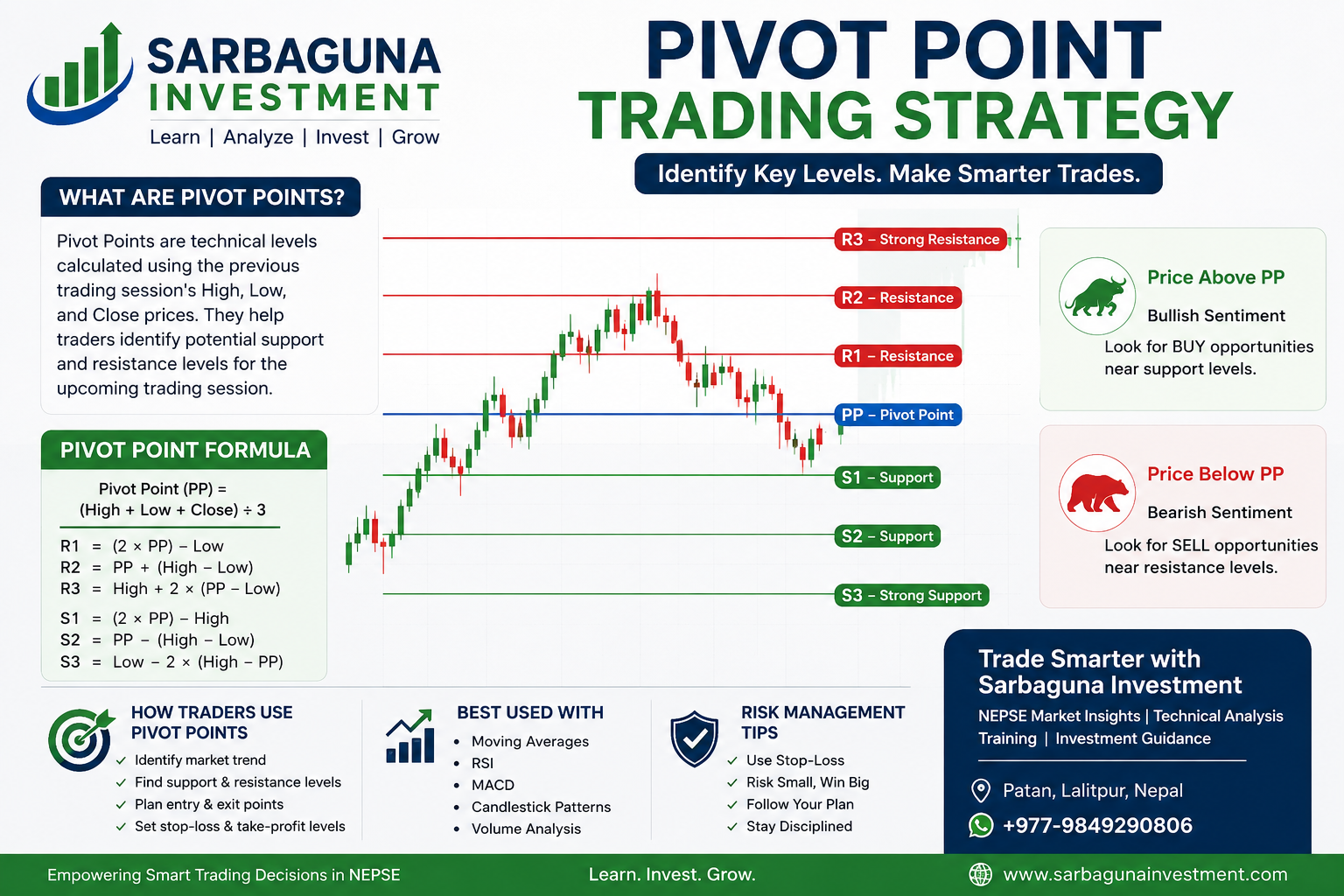
When the market trades above the pivot point, it generally indicates bullish sentiment. When the price remains below the pivot point, it suggests bearish sentiment.
Basic Pivot Point Formula
The standard pivot point is calculated as:
Pivot Point (PP) = (High + Low + Close) ÷ 3
From this central pivot, additional support and resistance levels are calculated:
- Resistance 1 (R1)
- Resistance 2 (R2)
- Resistance 3 (R3)
- Support 1 (S1)
- Support 2 (S2)
- Support 3 (S3)
These levels act as potential areas where price may reverse, pause, or break out.
How Traders Use Pivot Points
1. Trend Identification
The pivot point serves as a market bias indicator.
- Price above Pivot Point = Bullish Market
- Price below Pivot Point = Bearish Market
Many traders only take buy trades when the market is above the pivot and sell trades when it is below.
2. Support and Resistance Trading
Support and resistance levels generated from pivot points often become areas where price reacts.
Traders may:
- Buy near support levels
- Sell near resistance levels
- Watch for reversals or breakouts
3. Breakout Trading
Strong momentum above resistance levels can indicate a breakout.
Similarly, a move below support levels may signal continued downward momentum.
Breakout traders often use pivot levels as confirmation before entering trades.
Combining Pivot Points with Other Indicators
While pivot points are powerful, they become even more effective when combined with:
- Moving Averages
- RSI (Relative Strength Index)
- MACD
- Candlestick Patterns
- Volume Analysis
Using multiple indicators can increase the probability of successful trades and reduce false signals.
Risk Management Tips
No trading strategy guarantees profits. Successful traders always follow proper risk management.
Best practices include:
- Use stop-loss orders
- Risk only a small percentage of capital per trade
- Avoid emotional trading
- Follow a trading plan
- Maintain a favorable risk-to-reward ratio
Consistent risk management is often more important than finding perfect entries.
Pivot Points in NEPSE Trading
For Nepal Stock Exchange (NEPSE) traders, pivot points can be valuable for:
- Intraday trading
- Swing trading
- Identifying support and resistance
- Planning entry and exit zones
- Improving trade timing
When combined with technical analysis and market experience, pivot points can become an essential part of a trader's toolkit.
Conclusion
Pivot points offer a simple yet highly effective way to analyze market direction and identify important price levels. Whether you are a beginner or an experienced trader, understanding pivot point trading can help improve your decision-making process and trading confidence.
At Sarbaguna Investment, we provide practical stock market training designed to help traders master technical analysis tools like pivot points and develop profitable trading strategies in the NEPSE market.
Trading success comes from knowledge, discipline, and continuous learning—and pivot points are one step toward becoming a smarter trader.
Join Sarbaguna Investment
📊 Sarbaguna Investment – Empowering Smart Trading Decisions in NEPSE
📞 WhatsApp / SMS Pack: +977-9849290806
📍 Patan, Lalitpur, Nepal
💹 Daily Market Updates
📈 Technical Analysis Training
🎯 Trading Signals & Investment Insights
📚 Share Market Education
Learn. Invest. Grow. 🚀
Tags


Leave a Comments
Comments


Popular






Recent Post
No comments yet.