

Backtesting in Share Trading: Complete Guide for NEPSE & Global Stock Market Traders
What is Backtesting?
Backtesting is the process of testing a trading or investment strategy using historical market data to determine how it would have performed in the past. Instead of risking real money immediately, traders apply predefined buy and sell rules to previous price data and evaluate the results. While strong historical performance does not guarantee future returns, backtesting is widely used to evaluate a strategy's strengths, weaknesses, profitability, and risk before live trading.
Whether you trade NEPSE, NASDAQ, NYSE, or cryptocurrency markets, backtesting is one of the most valuable tools for building confidence in a trading system.
Why Backtesting is Important
Successful traders rarely rely on emotions or guesswork. Instead, they develop strategies based on data.
Backtesting helps traders:
- Test strategies before investing real money
- Measure historical profitability
- Identify maximum drawdown
- Calculate win rate
- Improve risk management
- Remove emotional decision-making
- Build confidence in a trading system
For Nepali investors, backtesting can be extremely useful for technical analysis strategies involving:
- Moving Averages
- RSI
- MACD
- Bollinger Bands
- Support & Resistance
- Breakout Trading
- Volume Analysis
- Candlestick Patterns
How Backtesting Works
A typical backtesting process includes the following steps:
Step 1: Define Your Trading Rules
Example:
- Buy when 20 EMA crosses above 50 EMA
- RSI below 30
- Volume higher than 20-day average
Step 2: Select Historical Data
Use historical price data covering multiple market conditions including:
- Bull Markets
- Bear Markets
- Sideways Markets
- High Volatility
Step 3: Run the Strategy
Apply the trading rules to historical data exactly as they would have been executed.
Step 4: Analyze Results
Review:
- Total Return
- Win Rate
- Average Profit
- Average Loss
- Profit Factor
- Maximum Drawdown
- Risk-Reward Ratio
Step 5: Improve Strategy
Refine your rules while avoiding over-optimization, then validate the strategy on unseen data before considering live trading.
Example of Backtesting
Suppose your strategy is:
Buy
- Price closes above 200 EMA
- RSI crosses above 50
- MACD Bullish Cross
Sell
- RSI above 70
- Price falls below 20 EMA
You test this strategy on five years of NEPSE historical data.
Results:
- 180 Trades
- 62% Win Rate
- Average Profit: 4.8%
- Average Loss: 2.1%
- Maximum Drawdown: 11%
- Annual Return: 24%
This provides evidence that the strategy had a historical edge, though future performance can differ.
Advantages of Backtesting
1. Reduces Emotional Trading
Trading decisions become rule-based instead of emotional.
2. Saves Money
Poor strategies can be discarded before risking capital.
3. Improves Confidence
Knowing how a strategy behaved historically helps traders follow it more consistently.
4. Measures Risk
Backtesting reveals worst-case historical drawdowns.
5. Strategy Comparison
Different strategies can be compared objectively.
Limitations of Backtesting
Despite its advantages, backtesting has limitations.
Past Performance Doesn't Guarantee Future Results
Markets evolve.
Curve Fitting
Excessively optimizing a strategy for historical data can make it fail in live markets.
Poor Quality Data
Incorrect or incomplete historical data leads to misleading results.
Ignoring Slippage and Costs
Real trading includes:
- Brokerage
- Taxes
- Slippage
- Liquidity constraints
These should be included for more realistic testing.
Common Backtesting Mistakes
Avoid these mistakes:
- Changing rules after seeing results
- Using only winning periods
- Ignoring transaction costs
- Overfitting parameters
- Looking ahead at future data
- Testing on too little historical data
- Ignoring market regime changes
Important Backtesting Metrics
Track these key metrics:
- Win Rate
- Net Profit
- Average Winning Trade
- Average Losing Trade
- Profit Factor
- Expectancy
- Sharpe Ratio
- Maximum Drawdown
- Recovery Factor
- Annual Return
- Number of Trades
Manual vs Automated Backtesting
| Manual Backtesting | Automated Backtesting |
|---|---|
| Uses charts manually | Software-based |
| Slower | Much faster |
| Good for beginners | Better for experienced traders |
| Limited data | Thousands of trades can be tested |
Best Practices for Effective Backtesting
- Use at least 3–10 years of quality historical data.
- Test across bull, bear, and sideways markets.
- Include realistic trading costs.
- Keep trading rules objective and simple.
- Validate on out-of-sample data before using real money.
- Combine backtesting with paper trading before going live.
Is Backtesting Useful for NEPSE?
Yes.
Although the Nepali market has lower liquidity than major global exchanges, backtesting can still help identify high-probability technical setups, improve discipline, and reduce emotional trading. Traders should account for liquidity, circuit limits, and transaction costs when evaluating results.
Conclusion
Backtesting is one of the most valuable tools for traders and investors. It helps evaluate whether a strategy had a historical edge, understand potential risks, and improve trading discipline. However, it should be combined with sound risk management, forward testing, and continuous review because markets change over time.
Frequently Asked Questions (FAQ)
What is backtesting in trading?
Backtesting is the process of testing a trading strategy using historical market data to evaluate how it would have performed before risking real money.
Does backtesting guarantee future profits?
No. Backtesting shows historical performance only. Future market conditions may differ significantly.
What data is needed for backtesting?
You need reliable historical price and volume data, along with clearly defined trading rules.
Is backtesting useful for NEPSE traders?
Yes. It can help NEPSE traders evaluate technical strategies, understand risk, and improve consistency.
What is the difference between backtesting and paper trading?
Backtesting uses historical data, while paper trading applies a strategy in the current market using virtual money.
Which indicators are commonly used in backtesting?
Popular indicators include Moving Averages, RSI, MACD, Bollinger Bands, Volume, Fibonacci Levels, and Support & Resistance.
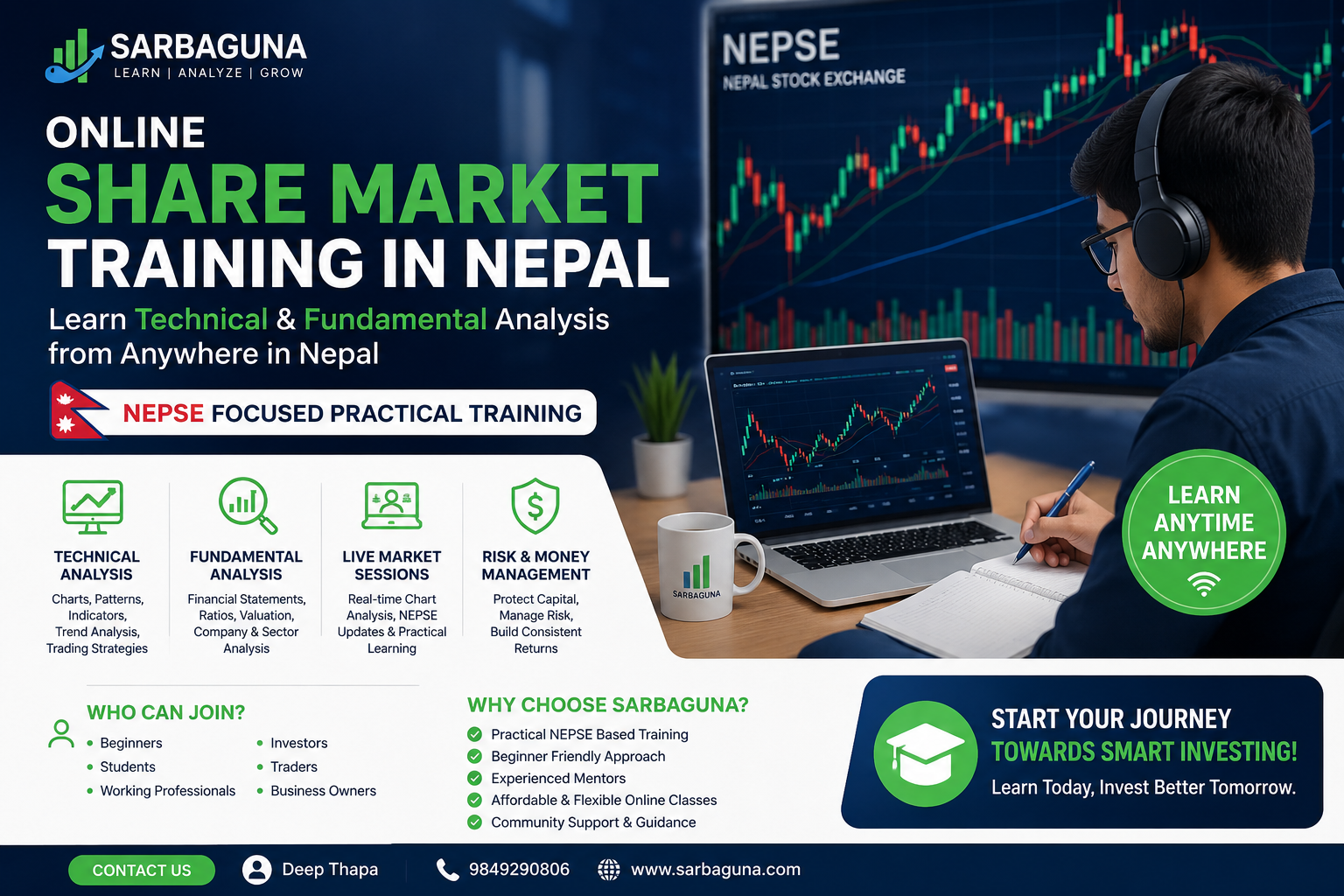
Share Market Training Nepal
Want to master Technical Analysis, Price Action, Backtesting, Risk Management, Portfolio Management, and NEPSE Trading Strategies?
Join Share Market Training Nepal by Sarbaguna Investment and learn practical investing and trading techniques from beginner to advanced level.
Contact: Deep Thapa
WhatsApp: 9849290806
Visit Sarbaguna: https://sarbaguna.com
Tags


Leave a Comments
Comments

Popular






Recent Post
No comments yet.