

Rasuwa Bhotekoshi Flood: Rescue, Relief & Hydropower Update
Rasuwa Bhotekoshi Flood: Rescue, Relief, Power and Road Restoration Update
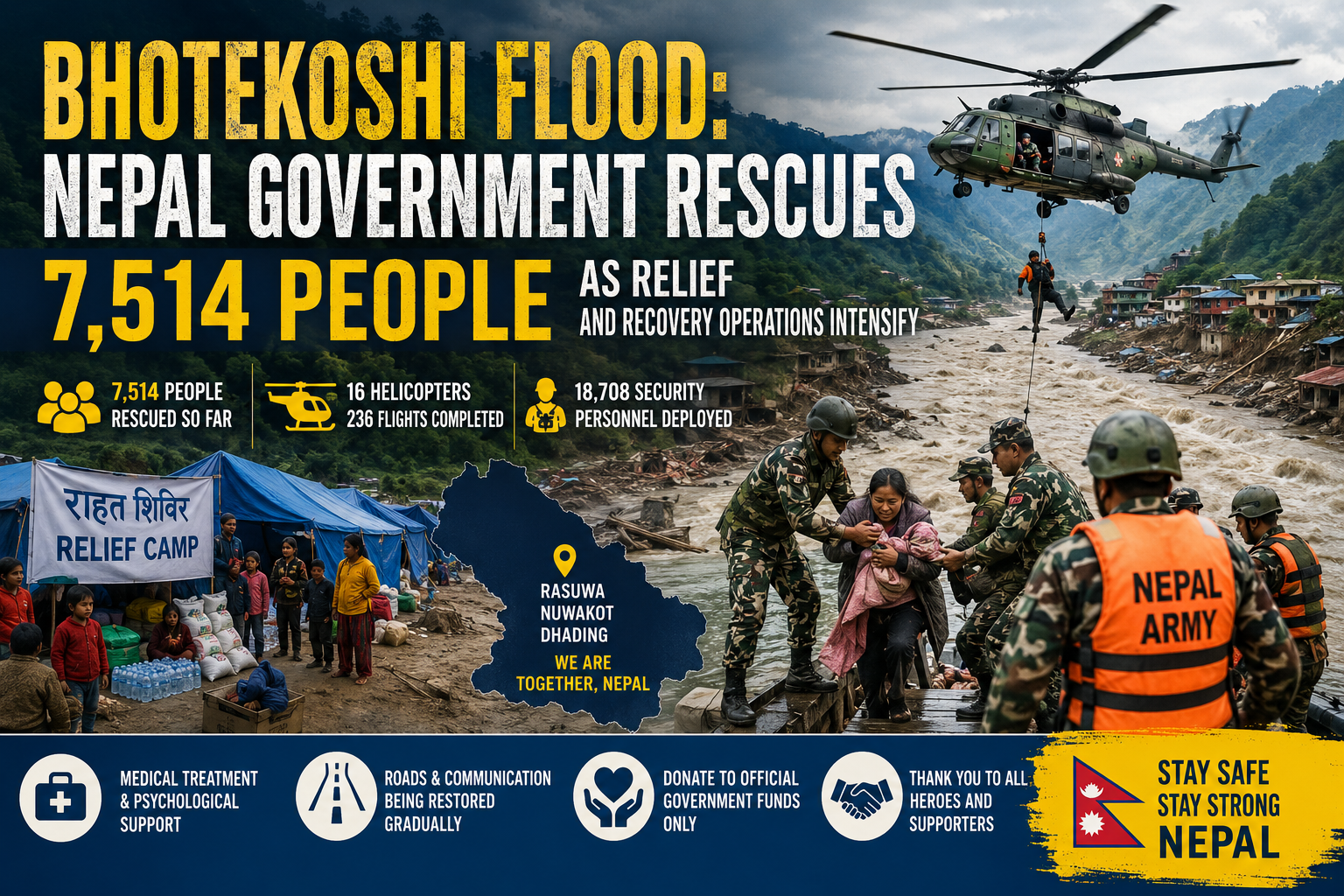
The Rasuwa Bhotekoshi flood has entered its sixth day, with the Government of Nepal continuing intensive search, rescue, treatment, relief distribution and rehabilitation efforts across the affected areas of Rasuwa, Nuwakot and Dhading.
The disaster has caused extensive damage to roads, bridges, hydropower projects, electricity infrastructure, communication networks and private property. Thousands of people have been rescued, while search operations continue for those who remain unaccounted for.
For investors and readers following Nepal's hydropower sector and share market, the scale of infrastructure damage also makes the disaster an important development to monitor.
Government Intensifies Search and Rescue Operations
The government has mobilized the Nepali Army, Nepal Police and Armed Police Force alongside government employees, local authorities, volunteers, media organizations and humanitarian groups.
As of the latest government briefing:
- 11,379 people have been rescued
- 3,925 people remain unaccounted for
- 279 injured people have been admitted to hospitals
- 168 injured people have already been discharged
- 939 bodies have been recovered, according to the statement
- Rescue operations remain active in several difficult-to-access areas
The government says the number of people reported missing may continue to change as communication and road access are restored.
Relief Distribution Reaches Thousands of Victims
Relief collection and distribution remain a major government priority alongside search and rescue.
Relief materials collected in Kathmandu and other parts of Nepal are being transported to affected communities through air and road networks.
International support has also been received from countries including India, China, the United States, the United Arab Emirates, Qatar, Japan, Switzerland and Australia.
Government security agencies have used four collection centers across Rasuwa, Nuwakot and Dhading and distributed relief through 27 distribution centers in Rasuwa and Nuwakot.
So far, relief has reached approximately 3,696 affected people.
Federal, provincial and local governments are coordinating shelter and relief operations, while officials and government staff have also been deployed directly to affected locations to monitor distribution.
Rs 5.87 Billion Raised Through Relief Funds
Financial assistance is also being collected through government relief mechanisms.
According to the government statement, by midday, approximately Rs 5.87 billion had been deposited into accounts maintained by nine commercial banks under the Prime Minister's Relief Fund.
In addition, approximately US$3.19 million had been deposited into accounts at Himalayan Bank and Laxmi Bank.
Several countries and organizations have also expressed commitments to provide additional financial support.
The government has stated that information about funds received through its relief mechanisms is being made publicly available to improve transparency.
Road Connectivity Restored in Nuwakot
One of the major developments is the restoration of road connectivity to areas across the Trishuli River in Nuwakot.
The road along the right bank of the Trishuli River under the Galchhi–Trishuli Highway has been reopened through Kalleritar, Koshikhola, Pipalatar, Darshantar, Chhatrekhola and Gauribesi to Trishuli Bazaar.
The reopening provides direct road access to a large number of residents and should make it easier to transport:
- Rescue teams
- Relief materials
- Food and essential goods
- Medical supplies
- Emergency equipment
However, numerous bridges in Rasuwa, Nuwakot and Dhading have been destroyed or damaged.
Government Plans Temporary Bailey Bridges
The government is prioritizing temporary bridge construction to restore transportation.
Nepal currently has:
- Six Bailey bridges measuring approximately 48 meters
- One Bailey bridge measuring approximately 70 meters
Studies have been completed for installing Bailey bridges at three locations:
- Devighat over the Tadi River
- Trishuli Bazaar
- Betravati Bazaar
India has also provided a 230-foot single-lane modular steel bridge and has committed to sending an additional seven Bailey bridges.
China is expected to provide 30 Bailey bridges as part of the emergency infrastructure response.
Electricity Restoration Progress in Rasuwa, Nuwakot and Dhading
The flood severely damaged electricity infrastructure across the affected districts.
In Rasuwa, electricity has been restored to approximately 30% of households, including areas around Kalikasthan, parts of Naukunda, parts of Gosainkunda Rural Municipality Wards 5 and 6, and the district headquarters Dhunche.
Preparations are also underway to supply electricity to parts of Amachhodingmo Rural Municipality through a separate system connected to the Sanjen hydropower project.
The government has dispatched 500 portable solar systems to support households in areas where grid electricity remains unavailable.
Nuwakot Electricity Restoration
Approximately 85% of Nuwakot has regained electricity service.
Authorities are working to restore the remaining 15% within the next five days.
Dhading Electricity Restoration
Approximately 98% of electricity service in Dhading has been restored.
The remaining affected areas are expected to receive electricity within two days, according to the government briefing.
Communication Services Gradually Recovering
Telecommunications infrastructure was also affected by the disaster.
According to the latest figures:
- 110 of Nepal Telecom's 120 BTS sites are operational
- 75 of Ncell's 78 towers have resumed service
The restoration of mobile networks is expected to improve coordination between rescue teams, government agencies and affected residents.
Hydropower Projects Hit by the Flood
The disaster has had a significant impact on Nepal's hydropower infrastructure.
Several hydropower projects in the Trishuli and Rasuwa corridor were affected, with some workers initially reported missing or unreachable.
The Nepali Army has so far rescued 279 people from various hydropower projects and continues search and rescue operations inside project tunnels.
Rasuwagadhi Hydropower Project
Two people have been rescued from the Rasuwagadhi Hydropower Project.
A joint Chinese and Nepali rescue team searched inside the tunnel. After no additional people were found, the rescue team returned.
Mailung Khola Hydropower Project
The Nepali Army has rescued nine people from the Mailung Khola Hydropower Project.
Upper Trishuli-1 Hydropower Project
A total of 254 people have been rescued from the Upper Trishuli-1 Hydropower Project.
Search and rescue operations inside the tunnel are continuing with Nepali, Korean and Chinese teams involved.
Upper Trishuli-3A
A team of approximately 90 personnel from the Nepali Army, Armed Police Force and Nepal Police is conducting search and rescue operations inside the Upper Trishuli-3A tunnel.
The Nepal Electricity Authority is also supporting the operation.
Upper Trishuli-3B
Two people have already been rescued from the Upper Trishuli-3B project area.
Additional Nepali Army personnel have been deployed, with a total of approximately 31 personnel involved in search and rescue activities.
Other Hydropower Projects
Rescue operations have also been conducted at:
- Trishuli Hydropower Project – 3 people rescued
- Solar project – 4 people rescued
- Devighat Hydropower Project – 4 people rescued
The condition of individual hydropower projects will remain an important issue for Nepal's energy sector and NEPSE hydropower stocks.
What Does the Rasuwa Flood Mean for Nepal's Share Market?
The flood has created uncertainty for investors holding hydropower and infrastructure-related stocks.
Potential short-term concerns include:
- Physical damage to hydropower projects
- Reconstruction and repair costs
- Temporary disruption of electricity generation
- Insurance claims
- Delays in project operations
- Damage to transmission and road infrastructure
- Impact on future cash flows
However, investors should avoid assuming that every hydropower company has suffered the same level of damage.
The actual financial impact will depend on each project's location, physical damage, insurance coverage, construction status, financing structure and expected recovery timeline.
For investors following Nepal share market news and hydropower stocks, company-specific disclosures and financial reports are therefore more important than panic-driven market movements.
A Major Himalayan Disaster Linked to Climate Risk
The government has described the Bhotekoshi flood as an unusually severe disaster originating from a Himalayan ice and rock avalanche.
The event highlights the growing risks faced by Himalayan communities and infrastructure as climate-related hazards become increasingly important.
For Nepal, the disaster raises broader questions about:
- Climate resilience
- Hydropower project design
- Early-warning systems
- Mountain risk assessment
- Road and bridge standards
- Disaster preparedness
- Emergency communication
- Protection of critical infrastructure
Nepal may also need to strengthen its international advocacy regarding the financial and humanitarian consequences of climate-related disasters in the Himalayan region.
Rehabilitation Is the Next Major Challenge
While search and rescue remain the immediate priority, the government has already begun planning rehabilitation.
Authorities are collecting information on the number of affected residents and the extent of physical damage in coordination with local governments.
Thousands of people have lost homes, family members, loved ones and property.
The next phase will therefore require more than emergency relief.
Long-term rehabilitation could involve:
- Temporary and permanent housing
- Financial assistance
- Reconstruction of roads and bridges
- Restoration of electricity and communication
- Rebuilding damaged infrastructure
- Support for displaced families
- Psychological and social support
- Recovery of local businesses and livelihoods
The government has stated that it will work to mobilize the financial resources necessary for rehabilitation and help affected communities return to normal life.
What Investors Should Watch Next
For Nepalese investors, the coming weeks could be important for understanding the economic and market consequences of the disaster.
Investors should closely monitor:
1. Hydropower company disclosures
Look for confirmed information about physical damage, generation losses, insurance and repair costs.
2. NEPSE market sentiment
Natural disasters can create short-term panic, but market reactions do not always reflect long-term company fundamentals.
3. Government reconstruction spending
Large-scale reconstruction could increase activity in construction, infrastructure, engineering and related industries.
4. Insurance claims
The eventual insurance coverage of damaged hydropower and infrastructure assets could materially affect company finances.
5. Electricity generation recovery
The timing of restoration at affected projects will be particularly important for hydropower investors.
6. Financial statements and corporate announcements
Investors should rely on verified company disclosures rather than social-media speculation.
Frequently Asked Questions (FAQ)
What happened in Rasuwa?
A severe flood affected the Bhotekoshi River area of Rasuwa, causing extensive damage to infrastructure, roads, bridges, hydropower projects, electricity systems and communities.
How many people have been rescued from the Rasuwa flood?
According to the latest government briefing provided in the statement, 11,379 people have been rescued from the affected areas.
How many people are still missing?
The government statement reported 3,925 people as unaccounted for, although the figure may change as communication and access improve.
How many injured people have been treated?
A total of 279 injured people were admitted to hospitals, of whom 168 had been discharged by the time of the briefing.
How many bodies have been recovered?
The government statement reported that 939 bodies had been recovered and were being managed according to the applicable procedures.
How is the government distributing relief?
Relief materials are being collected from Kathmandu and other parts of Nepal and transported through air and road networks to collection and distribution centers in the affected districts.
Has electricity been restored in the affected areas?
Yes. Around 30% of households in Rasuwa, 85% of Nuwakot, and 98% of Dhading had regained electricity service according to the latest government update.
Are hydropower projects affected?
Yes. Several hydropower projects in Rasuwa and Nuwakot have been affected, and rescue teams are continuing operations at several project sites and tunnels.
Will the Rasuwa flood affect NEPSE hydropower stocks?
It could affect individual hydropower companies depending on physical damage, insurance coverage, generation disruption and repair costs. Investors should wait for official company disclosures before making conclusions.
This article is based on the government briefing and information provided in the source statement. Disaster-related figures can change as rescue, identification and verification operations continue. Information about individual companies and hydropower projects should be confirmed through official disclosures before making investment decisions. This article is for informational purposes and does not constitute investment advice.


Leave a Comments
Comments

Popular





No comments yet.